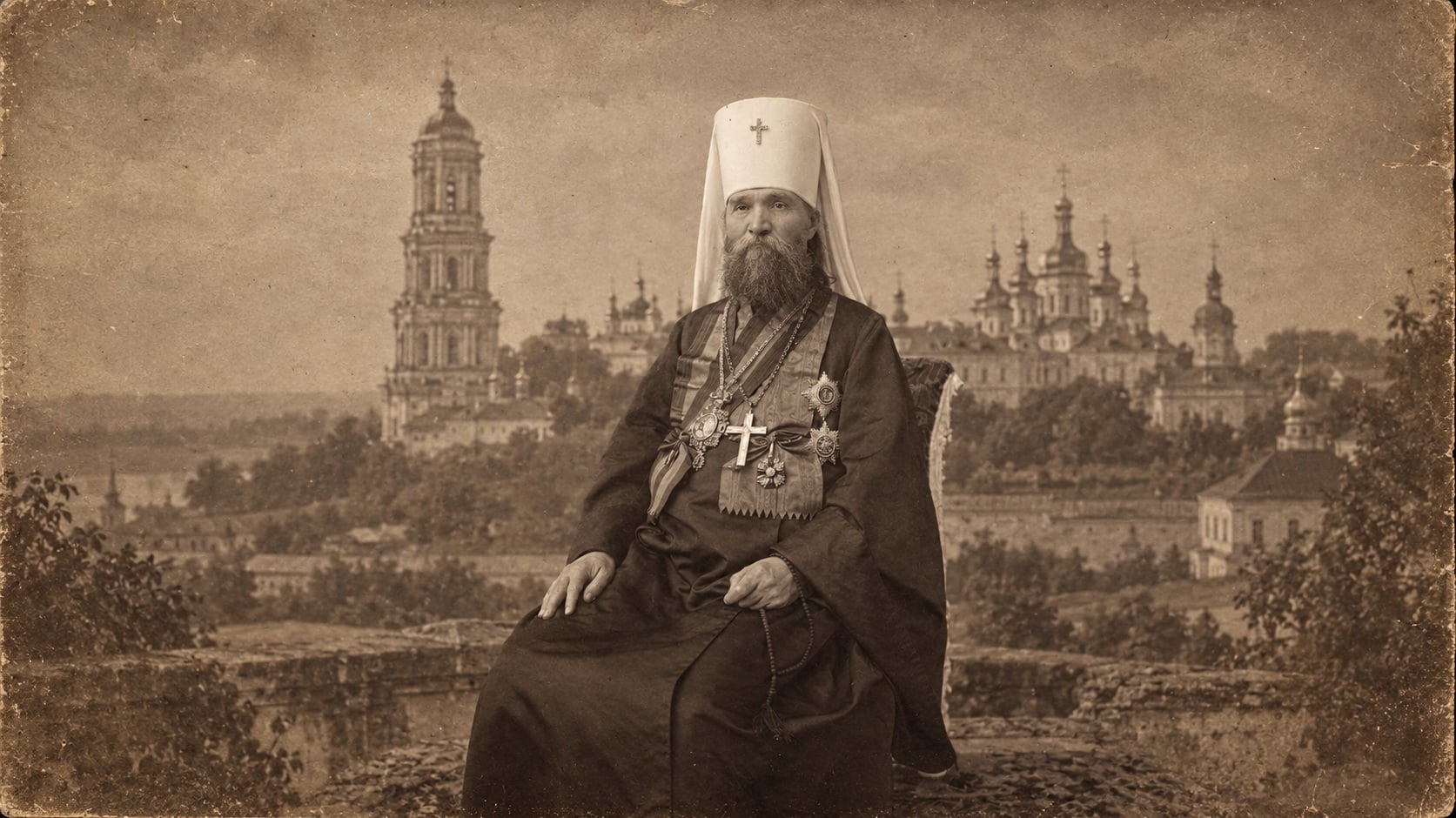
The blessedness of those persecuted for righteousness' sake
Metropolitan Vladimir's appointment to Kyiv was more an exile than simply a transfer to a new see — he had not proved "acceptable at court". Then again, how much is needed to earn disfavour, especially in the eyes of people vested with power. "Do your work, speak the truth, do not toady — and that is quite enough." And the metropolitan himself, having barely learned of his appointment to Petrograd, seemed to foretell it: "I am not a man of etiquette, I may not prove 'acceptable at court' there — there are various currents there, and I shall not be able to follow them; I have not the character for adaptability."
Indeed, there was no shortage of dangerous currents around the imperial court. Grishka Rasputin alone was enough — a Siberian wanderer who threw himself now into ascetic feats, now into debauchery, and who, thanks to the trust of the imperial family, became so influential that officials and even bishops sought his favour. "He removed ministers and shuffled courtiers like a pack of cards. His disfavour was feared more than the tsar's wrath."
Metropolitan Vladimir would not be reconciled to this flagrant insolence, or even simply turn a blind eye to it. In the summer of 1915 he obtained an audience with Emperor Nicholas II and spoke out directly against the interference of outsiders in church affairs, and of Rasputin in particular.
"Yes, this was a living example to our hierarchs," Archbishop Antony (Khrapovitsky) said in admiration of the metropolitan's act, "while others had become utterly steeped in falsehood and were constantly betraying their own convictions, Metropolitan Vladimir was not afraid to speak 'the truth to kings'." And this at the age of 67, when everyone else has no care but for the quiet course of life. Incidentally, His Eminence Vladimir was then strongly advised to retire. "By human reckoning I agree with you, it is time to know when to stop," the metropolitan replied, "but by God's reckoning — how? Is it fitting to test and to forestall the will of God? And what of the duty we swore an oath to fulfil? They will say that I left out of wounded pride. No, evidently such is the will of God. And it is all one where a man dies."
The fracture of war
Kyiv differed sharply from the northern capital, which was forever hurrying somewhere. It was "a quiet backwater… The people of Kyiv are quiet, slow and without any Americanisation at all." Except that the war had made its own corrections to the life of the city. "There was not enough oil or kerosene. The power stations worked with interruptions… Prices for everything had risen 2–3 times… Queues for bread, meat, sugar… The old, beautiful, clean city was unrecognisable: streets littered with rubbish, dim lighting, especially on the outskirts… The infirmaries were overflowing with the wounded. The soldiers were irritated by the heavy losses at the front, by the disorganisation of life and by the shortage of food in the rear."
This soldierly pain troubled Metropolitan Vladimir deeply as well. In mid-January he set out for the army in the field "to impart his blessing". At the same time he visited the infirmaries of the city and of the Lavra. There he went round "all the wards and all the wounded and the sick. Each soldier he questioned with fatherly love and attention about his family circumstances, about the wounds he had received in battle, about how he bore the hardships of the war and about his state of soul; he comforted them all kindly and gave to each the Holy Gospel as a blessing." He wanted to encourage and to support the soldiers, to bring at least a little joy into their hearts. For even from the faces of the men it was plain that their former steadiness had been shaken. Meekness and the silent readiness for self-sacrifice had died away.
The failures at the front, with the loss of the western provinces, only made the condition of the troops worse. "In 1915–1916 about 2 million men deserted from the army." They were ready for any mutiny so long as they were not driven into the trenches. The discontent of the soldiers spread to the workers. Strikes began at the defence factories. And the further it went, the grimmer things became. Especially in the northern capital, where in February 1917 the troops went over to the revolution altogether.
The rhythm of the new age
The news that the old authority had been overthrown and that a Provisional Government had been formed in its place was met with "a sigh of relief from many millions". Everyone was terribly glad. Confidence hung in the air that, having set out on the path of democratic renewal, the country would soon "begin to build a new and happy future". Even in the Synod the coup was received calmly enough, so that on the third day after the emperor's abdication they issued a resolution: "The will of God has been accomplished. Russia has entered upon the path of a new life as a state."
Democratisation did indeed become a new feature of the state. "Not to be read, not to hear applause — to anyone this seemed the same as not living. And everyone pressed into the very thick of that agitation which so easily took hold of mankind." "Kyiv, and indeed every city of the empire, turned into a platform for meetings. The meeting was continuous. It began early in the morning and went on until late at night. Anyone who wished took part in it. The venue of the meeting was the city gardens and parks, the boulevards and the squares. The soldiers stopped their drill and their training and took over the gardens. One after another the orators climbed onto the rostrum — usually a bench, a table, the plinth of a monument. Everyone wanted to say his word… Those who called for the war to be continued were met with shouts of 'down with him' and driven from the rostrum." In the streets — processions, the "Marseillaise", red rosettes, red flags. Priests, officials — all in rosettes. Everywhere diocesan assemblies were hastily convened, the shortcomings of church life were discussed, all manner of demands and wishes were adopted.
Society was changing literally before one's eyes. Together with the poet's call to "leave curiosity to the crowd and side with genius", the culture of modesty, the sense of hierarchy and the ability to recognise a counterfeit all began to pass into oblivion. "Truth" now belonged to whoever could shout the loudest. No one cared any longer to preserve that "fragrance which is always brought into civilisation by the individual efforts of exceptional people, and without which life would be burdensome or, at the very least, comfortless and harsh."
And it was precisely harshness that became the characteristic feature of the new age. And if March-April 1917 could still be called the "honeymoon months" of the revolution, then what "began afterwards and continued for four years defies all description… By the reckoning of the people of Kyiv there were 18 coups… and it thundered and seethed and blazed not only in Kyiv itself but in its suburbs too." "In the villages, robbery and brigandage; in the districts, the sacking of landowners' estates and the murder of the landowners. It happened that on a feast day the village would go to church, and after the liturgy the whole community would plunder the neighbouring estates… They raged most of all in the zone near the front. There it was simply a bacchanalia. And no wonder! Everyone was armed, everyone had grown used at the war to human life being worth nothing." "Drunkenness and robbery were entangled in one inseparable knot. This was the genuine 'creativity' of the popular masses — initiative from below."
With catastrophe closing in on the country, and especially in the summer, when the shooting of demonstrations began in the streets of Petrograd and riots followed after them, the Holy Synod issued an epistle to the children of the Church and the citizens of Russia "concerning the extraordinary circumstances of the present time": "…The hour of civil freedom has struck for Rus'… And hope blossomed that Rus', having thrown off the political chains that bound her, would turn all her might to her own liberation from the German yoke, and all her reason to the peaceful inward development and ordering of the state and of the common good of the people. Yet, to the country's deep sorrow, it was not long that the long-suffering Motherland was granted to live by that hope. Following freedom, a new and evil enemy made its way in among us and sowed tares in Rus'… Embezzlement, robbery, brigandage, violence and the sharpened struggle of party politics became the substance of our new life and planted in the people a bitterness and a discord that brought in their train an internal fratricidal war and bloodshed more than once. And as a result, in place of freedom — a new mutual oppression; in place of brotherhood — a cooling of love, a decay of good, peaceful, brotherly relations in society. The country has taken the road of ruin, and in the future there awaits it that dreadful abyss which is filled for us all with appalling despair, unless there cease 'trouble, and of treading down, and of perplexity by the Lord GOD'(Is. 22:5, King James Version)."
On the brink of schism
Meanwhile, in the Kyiv committee of clergy and laity the supporters of separation would not hear of any brotherhood. Seized with a petty-bourgeois delight at the chance to get their hands on the settling of the chief church questions, they spoke with extreme hostility both against the Synod and against the Metropolitan of Kyiv. Neither the Synod's concessions on the language question nor the entreaties and admonitions of the metropolitan himself were of any help: "Pastors and flock! With all the fullness of my archpastoral love I beseech you, uphold by every means your unity among yourselves and with the whole Orthodox Russian Church — in this lies the happiness, the greatness and the strength of all the Russian people, both in the past and in the future. At the present time this unity is especially needed for a successful struggle with our enemies, inward and outward… I beseech you to remember that if you are called to take an active part in the diocesan administration of the Church, then by that very fact a great responsibility before the whole Church of Kyiv is laid upon you. Take up such great obligations of yours as you ought — attentively, diligently, patiently and, above all, having in your heart the spirit of Christ; and let there be no divisions or enmity among you.
Moreover, — Metropolitan Vladimir continued his admonition, — at the present time the number of people grows ever greater who understand neither the loftiness of the Christian religion nor its spirit.., who count it the highest merit to be liberal in matters of faith and morals. Many find a particular merit in instilling such a liberal attitude into the souls of Russian people… [Yet] it must not be forgotten that the Christian faith is not a human invention but the words of God, and it cannot change in accordance with human notions; and if human convictions stand in contradiction to divine truths, is it reasonable to attach any significance to those convictions, to hold them right and to be guided by them in life? We must of course bear with those who do not agree with us and even with those in manifest error, and treat them with forbearance; but from their errors we must turn away, and with error we must struggle and prove its groundlessness. Both the pastors of the Christian Church and the true followers of Christ's teaching must count this their duty…
To the general calamity throughout the Russian land there is added our own local one, which increases our inward sorrow not a little. I speak of that mood which has appeared in southern Russia and threatens a breach of church peace and unity. It is dreadful for us even to hear people speak of separating the South Russian church from the one Orthodox Russian Church. After so long a common life, have these aspirations any reasonable grounds at all? Whence do they come? Was it not from Kyiv that the preachers of Orthodoxy went out over the whole of Russia? Among the saints of the Kyiv-Pechersk Lavra do we not see those who came here from various places of Holy Rus'? Did not the Orthodox of southern Russia labour in every part of Russia as churchmen, as scholars and in various other fields; and conversely, did not the Orthodox of the north of Russia also strive in every field in southern Russia? Did not both together build up the one great Orthodox Russian Church? Can the Orthodox of southern Russia reproach the Orthodox of northern Russia with having departed in anything from the faith or distorted the teaching of faith and morals? In no case… What then is this striving for separation? What will it lead to? Only, of course, the gladdening of enemies inward and outward. Love for one's own native land must not in us drown out and overcome love for the one Orthodox Russian Church."
After repeated attempts to get through to his opponents, or at least to soften their aggressive tone — opponents who wanted nothing but a pretext for discord — the hierarch was so shaken and fell into such distress that he felt unwell and returned to the Lavra barely alive. In the coming days he was to open the All-Russian Church Council in Moscow.
The Local Council
The opening of the Local Council was perhaps the most important event in the religious life of the era of the Provisional Government. The need to convene it had long since become pressing, and the distant revolution of 1905 may be said to have been its prologue. At that time, after the reforms of the structure of the state, the Synod thought it necessary to learn what changes the ruling bishops considered necessary in church life. A good many responded to the enquiry. Whole treatises of various proposals were received, and over the following two years the Pre-Conciliar Commission worked diligently on all this material, in the end compiling four volumes of memoranda. But the matter went no further — very influential opponents of it were found in the government. Now, however, when the Synod had adopted the "Regulations on the Convocation of the Council", this most valuable material was taken as the basis.
The Council opened on 28 August. Around the Dormition Cathedral in the Kremlin there gathered "countless crowds of people… Processions with the cross from all the cathedrals, monasteries and churches of Moscow… A forest of banners… From the ambo Metropolitan Vladimir read out the charter of the Most Holy Synod on the opening of the Council and invited the members of the Council to recite the Creed… Throughout the whole day the bells rang without ceasing in all the churches."
On the third day the working sessions began. Commissions were set up: administrative, diocesan, parish, educational, liturgical, economic and so on (Metropolitan Vladimir headed the committee on church discipline). Along the way various questions were discussed: the restoration of the patriarchate, relations with the state, the language of the services, the system of education… Particularly heated and interesting debates arose in the department dealing with the question of translating the services. "Professor Kudryavtsev expressed thoughts which many shared. 'I have nothing against a translation,' he said, 'but who is going to translate? The services are sacred poetry. If Shakespeare is hard to translate, because the translator must be equal to the poetry he is translating, then for the services one needs not merely a poet but a holy poet. We have translations of some passages of St John of Damascus made by Aleksey Tolstoy, but even this is only an approach to the real thing…' The question of translating the services was rejected. The Ukrainians were indignant. They were for a translation regardless of considerations of aesthetics." Naturally — in Kyiv preparations had been under way since the beginning of May for publishing the Holy Scriptures in Ukrainian.
In November the work of the Council had to be suspended. The whole of Moscow was engulfed in civil war. Fierce shooting, the rattle of machine guns, the cannonade of the guns, the storming of the Kremlin. "At a session of the Council it was decided to send a delegation of bishops, priests and laymen to the revolutionary headquarters. The Bolsheviks did not receive the delegation; they let in Metropolitan Platon alone. In answer to his entreaties to stop the bloodshed the commissar shouted: 'Too late! Tell the cadets to surrender…' Metropolitan Platon went down on his knees… But the Bolsheviks were implacable. The Council's attempt to intervene in the internecine strife proved fruitless." For the overwhelming majority of the members of the Council, however, the Bolshevik seizure of power seemed a kind of historical accident. No one supposed that the Bolshevik regime was there to stay.
The work of the Council was soon resumed, and "after two months of speeches 'for' and 'against' the patriarchate was restored by an overwhelming majority". On 18 November his election took place in the Cathedral of Christ the Saviour. "On the analogion before the Vladimir icon of the Mother of God was set a casket with three slips of paper on which were written the names of the candidates [who had received a majority of the votes in the previous rounds of voting]. Which of the three hierarchs was to be chosen as Patriarch? In this decisive vote only the bishops had the right to take part. But they resolved to renounce their right and to rely upon the Lord, that is, they decreed that the Patriarch should be chosen by lot… The church, which held up to 12000 worshippers, was packed. All waited with trembling to hear whom the Lord would name… At the end of the moleben Metropolitan Vladimir came up to the analogion, took the casket, blessed the people with it, broke the cord with which the casket was tied — and removed the seals. From the sanctuary there came out a very old man — the hieroschemamonk Alexy, the recluse of the Zosima Hermitage. He crossed himself three times and, without looking, drew a slip out of the casket. Metropolitan Vladimir read out distinctly: 'Tikhon, Metropolitan of Moscow'. It was as though an electric spark ran through those at prayer… The metropolitan's cry rang out: 'Axios!', and it was drowned in the unanimous 'Axios!.. Axios!..' of the clergy and the people. The choir together with the worshippers began to sing 'We praise Thee, O God'… Exultation seized them all. Many had tears in their eyes. One felt that the election of a Patriarch was a joy for everyone, that now everyone had a defender, an intercessor, a father… Everyone wanted to believe that with a Patriarch the discords would somehow be outlived."
At the enthronement Metropolitan Vladimir addressed the chosen one with these words: "How much discernment is required of a leader of the Church! And what great forces of spiritual robbers — atheists, materialists, socialists and the like — stand in the way of the Holy Church of Christ! How much foresight, therefore, is required of the helmsman of the Church. And indeed on the ship of the Church itself there are shipmen who enter into conspiracy with the adversaries of the Church of Christ. Even in peaceful times it is hard to steer the ship of the Church, and in our time… this is a terrible time for the Church! Her position is dreadful… But let not thy heart be troubled, Most Holy Patriarch. Be not dismayed at these enemies of God's Holy Church. For thou art not alone and not helpless. With thee is He who has shown thee to be Patriarch; with thee is our Protectress the Mother of God; with thee are the holy metropolitans of Moscow and of all Russia."
Metropolitan Tikhon was in general a very lively man and did not resemble the typical bishop. One Galician priest left a remarkable comment about him: "the parish was visited by His Grace Tikhon — for the first time I see a man in a bishop." Third among those chosen by men, he turned out to be first among those chosen by God. And not simply the first patriarch, but a holy patriarch. In this whole story, though, if anything is to be wondered at, it is only why election by lot has still not become a firm tradition of the Church.


Comments