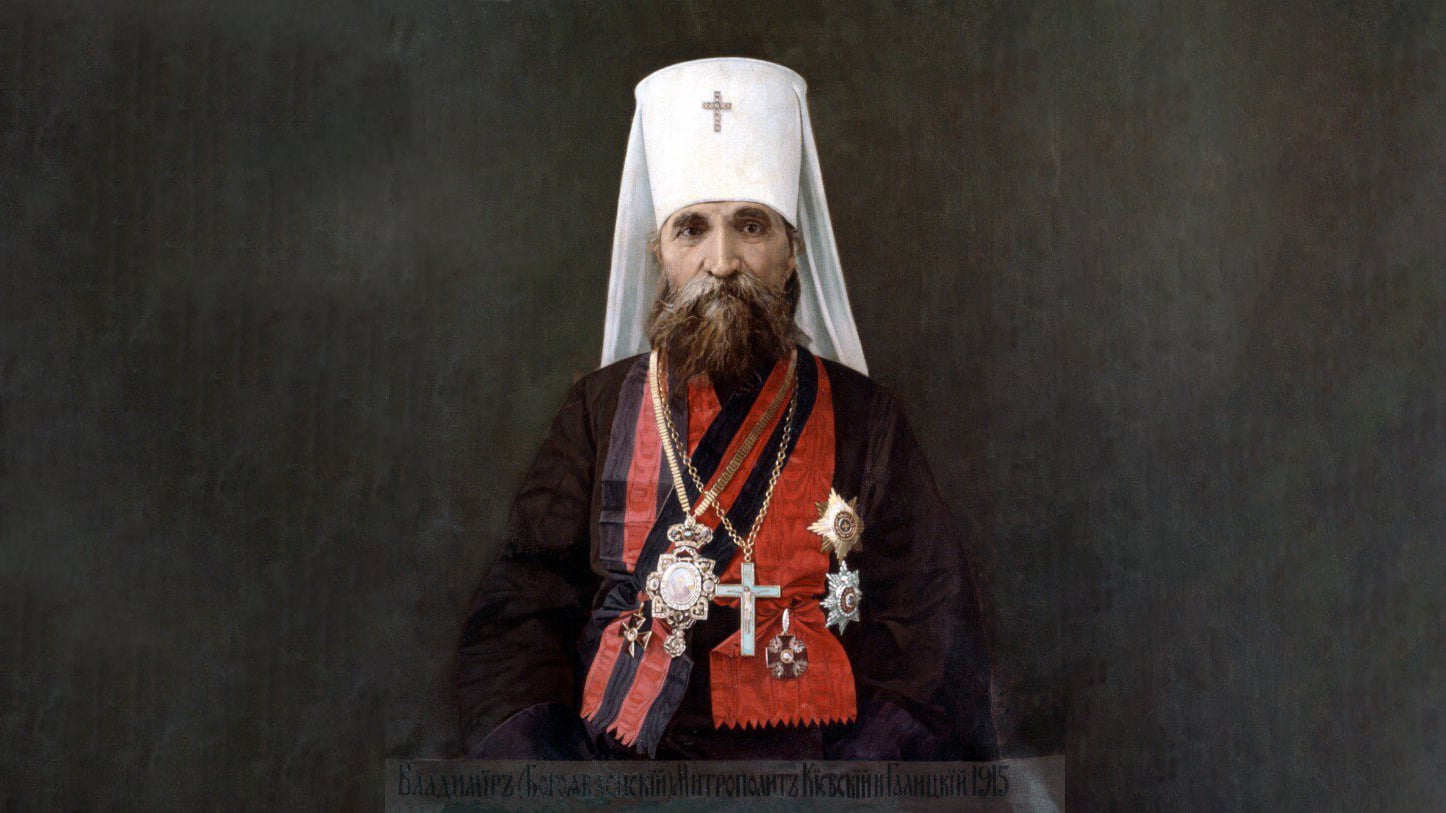
Autocephalist ferment
Meanwhile the church disorders in Kyiv only kept growing. The supporters of separation, not themselves noticing how they were becoming hostages of a political adventure, first united in the All-Ukrainian Church Rada, and then, not without the help of the military, began to push the initiative of convening a church council of their own. Apart from the political one, this undertaking answered no other need, still less a church need, if only because "the decisions of the All-Russian Council in Moscow were so broad that they answered the needs of Ukraine as well. Besides, the Ukrainian dioceses were widely represented in Moscow by bishops, by clergy and by laity alike. They were able to defend the lawful and useful needs of Ukraine with dignity".
It is just that the Church Rada lived by entirely different concerns, and in general it presented an extraordinary mixture of everything under the sun. Its membership included up to fifty people from various organisations: priests, military men, professors… "For them there was no history, there was no kinship of blood. To say nothing of the faith, of the Church. There was only a loud, frenzied hatred of the Great Russians, the 'moskali'". And so frantic was it that even priests were not ashamed of calls to "knife the katsapy!". "Among them a prominent place, by his fanaticism, his age and even his enormous greying beard, was held by Archpriest Vasyl Lypkivsky". This company was headed by the former Archbishop of Vladimir, Alexy (Doroditsyn), whom after the February revolution his own flock drove out of Vladimir for being on too friendly terms with Rasputin.
How to undermine trust in Patriarch Tikhon and at the same time remove Metropolitan Vladimir from the see of Kyiv? — that was what troubled this whole Rada first of all. To that end rumours were spread about the Patriarch as a "new autocrat", through whom "the Russians" were seeking to cast the Ukrainian people into a new "spiritual bondage". As for Metropolitan Vladimir, an open letter appeared in the Kyiv press with a resolute request that he not return "to our capital Kyiv, where the only thing you know how to do is to spoil every good work".
Happily, very few Orthodox Christians shared these ideas. "The heads of the Ukrainian dioceses in the main did not recognise the Church Rada and declared their loyalty to the Most Holy Synod". And the assembly of the Union of Orthodox Parishes of Kyiv went so far as to resolve "to protest against the anti-canonical attempt to create an autocephalous Ukrainian church" and to recognise "the presence of the Metropolitan of Kyiv outside Kyiv at such an anxious time as an undesirable phenomenon".
It is just that for the Church Rada this was no obstacle, and Metropolitan Vladimir, who returned in the first half of December, at once found himself within its field of action. At times during the services he heard shouts and abuse addressed to him. Demands that he leave Kyiv for ever were put to him by various groups of priests. In the end it came to outright threats, so that Lypkivsky was already rubbing his hands: "Metropolitan Vladimir will in any case be removed from Kyiv".
Incidentally, Metropolitan Vladimir was not the only one whom the Church Rada threatened. Professor of the Theological Academy Archpriest Feodor Titov stated that he had received from that same Rada a written warning: should he speak against it at a session, he would be killed! But while the married archpriest's associates did manage to persuade him not to risk his own life, Metropolitan Vladimir was unbending: "I fear no one and nothing. I am ready at any time to give up my life for the Church of Christ and for the Orthodox faith, if only to give her enemies no cause to mock her. To the end of my life I shall suffer, that Orthodoxy may be preserved in Russia there where it began".
The All-Ukrainian Church Council
The opening of the All-Ukrainian Council fell on 20 January 1918. Those who gathered for it were "people so unsuited to difficult and serious work that it was even frightening. A crowd of embittered Ukrainians, inflamed by political passions… as if broken loose from their chains, they rushed about among the council members, agitating, stirring them up, forcing decisions upon them. Against Moscow, of course, against the moskali, the katsapy, these 'enemies of dear mother — Ukraine'. The shouts 'Down with Moscow!', 'Let us free ourselves from the Moscow yoke!..' had great success. The sessions proceeded in heated rally speeches".
Nevertheless, Metropolitan Vladimir did not miss a single assembly, went into every matter in detail, and along the way called everyone to careful, serious and thoughtful work.
And yet the Local Council in Moscow had begun with a similar "disorder, discontent, even mutual mistrust". And how everything changed after its participants travelled to venerate the relics of Saint Sergius: "the delegates returned refreshed by the spirit of grace, at peace; people who had been strangers to one another drew closer, the implacable softened".
Something similar happened in Kyiv too. Here somebody likewise advised that they all go together to venerate the venerable fathers of the Caves. And indeed, after a common Liturgy in the Great Church of the Lavra and a visit to the Near and Far Caves, "a considerable pacification" took place. It is just that from then on everything went by an entirely different scenario. It was on that very day, 27 January, that the first shell flew onto the territory of the Lavra — thus did the approaching Bolshevik troops make themselves known. They were drawing near to Kyiv, taking one station after another, and by 28 January they were on the left bank of the Dnipro.
From early morning on 30 January an unceasing roar of guns arose. "This was a real artillery attack, long remembered by the people of Kyiv. The city was shelled alternately from three-inch and from heavy field six-inch guns. By the reckoning of the Kyiv artillerymen, between 7000 and 10000 shells a day were fired at Kyiv. The bombardment began at 7 o'clock in the morning and continued until one at night".
"Panic at the Council… The Ukrainians grew meek — and were at a loss: 'Ah, Vladyka… what is to be done, Vladyka?.. bless us, Vladyka!..' How everything had changed!.. The Council was closed until a better time, having managed to decide nothing in those two or three weeks".
***
All these supporters of purely nationalist ideas are marked by some seal of doom — fighters for "something that is to be realisable but is never realised". "To humiliate in every way all that is above them, to deprive of rights, to restrict, to win privileges for themselves — such are their properties". And together with that "from Christianity, from Orthodoxy at any rate, the last 'marks' of universality are disappearing". Unity in God is imperceptibly replaced by national unity. And "so long as people believe that one may and must serve Russia or Ukraine or indeed anything at all in this world, they are all the same serving idols, and that service is a dead end".
In a besieged fortress
In the Lavra itself the former relations of trust towards its own sacred archimandrite gradually began to crack. The wedge of discord was driven into them especially firmly by that same Archbishop Alexy. Having settled in the Lavra from the autumn, he "began to stir up the Ukrainian monks. It would happen that Metropolitan Vladimir needed to travel somewhere, and the monks would not give him horses and declared: 'Vladyka Alexy has gone off with the horses'".
On the other hand, the degree of mistrust towards Vladyka Vladimir was raised also by Archimandrite Kliment. Having obtained the removal of the vicar of the Lavra, Archimandrite Amvrosy, who was going blind but was splendid and pure of soul, he seized his place and with the help of his supporters began to promote among the brethren "those moods which did not justify the presence of the Metropolitan as the superior of the Lavra".
"In the diary of the Metropolitan's personal cell-attendant it is noted that a few days before the murder some delegation of monastics came to Vladyka, headed by the vicar Kliment, 'all of them loudmouths and cut-throats'; they spoke about something loudly and heatedly, and in tones far from reverence towards the Metropolitan. They 'pressed' the Metropolitan and insistently demanded something… the conversation mentioned was conducted in such tones that the Metropolitan, after the delegation had withdrawn, said: 'Do you see what they are doing?'".
All this created a burdensome situation, which came to the point that Vladyka "felt himself in the metropolitan's quarters of the Lavra as if in a besieged fortress". And then there was the Bolshevik invasion as well. The shelling, especially in the first days of February, began to inflict serious damage on the Lavra buildings. In the city too the destruction was great. "Fires broke out, and the flames of the burning houses made a dreadful impression. The water supply in the city was not working, and the fire brigades did not even try to put out the burning houses". The population of Kyiv felt utterly helpless and defenceless, expecting death at any minute. "It had been caught unawares. No one had thought it necessary on the eve of those days to lay in stocks of food. What remained was either to go hungry or to look for food at the risk of coming under a shell". "Believers naturally gathered around their holy place in the Kyiv-Pechersk Lavra. Night services were held, they prayed until morning". But even here they did not feel themselves fully safe.
On the evening of 5 February the Red Guard occupied the Lavra. The garrison commandant came to Archimandrite Kliment with a warning: "I shall be living in the Lavra hotel, I have a telephone line to you. If gangs break in on you with a search, with a demand for money, or if anything else happens — call me".
In those nightmarish days armed gangs were indeed masters of the city. They robbed and killed people with impunity. It is understandable that "the Lavra was a most tempting object for the bandits. On the one hand, everyone knew what enormous treasures were concentrated in the monastery, and much was said about the wealth of the monks. On the other hand, the Lavra and the monks were utterly defenceless… They did not know how and were not able to stand up for themselves. The majority of the bandits were of a strictly revolutionary disposition". "They burst into the churches, with caps on their heads and cigarettes in their teeth, made shouting, noise and outrages during the services, uttered unspeakable curses and blasphemies against the holy place, broke into the monks' dwellings by day and by night… searched and robbed, jeered and flogged with whips… Such acts of violence went on throughout the whole day of 6 February".
It was precisely on that day, in the morning before the Liturgy in the Great Church, that Metropolitan Vladimir served the akathist to the Dormition of the Mother of God, performing the last sacred rite of his life.
The day of the killing
On Thursday 7 February, at about three in the afternoon, an armed band of about five men, entering through the central gates, made straight for the Lavra refectory. "While the monks were feeding them, the questioning began: [And why do you have no committees?] was the brotherhood content with its superiors? did the monks have any complaints?.. The novices began to complain of oppression: the people bring great sums of money to the Lavra, and 'he' devours them… — and they pointed upstairs, where the Metropolitan's quarters were". Before leaving, one of the raiders declared: "You will not see the Metropolitan again…".
"Bishop Feodor of Pryluky, who was at that time a guest of Metropolitan Vladimir, relates it roughly thus. After dinner he and Vladyka went up onto the upper terrace, from which a distant view opens over the lands beyond the Dnipro, and they began to watch the battle which was at that time being fought between the Ukrainian units and the Bolsheviks. The Metropolitan attentively followed the bursting of the shells and made his own apt remarks. At that moment the cell-attendant appeared and reported that some armed men had come and were asking for the Metropolitan. Vladyka went out into the reception room".
The uninvited guests at once dragged him into the bedroom. What went on there is unknown. Except that the soldier who remained in the reception room gave the cell-attendant to understand that they intended to "deal with the Metropolitan for offending the brotherhood, taking away half the Lavra's income and not allowing the monks to set up a brotherhood council".
After about two hours Vladyka was led back into the reception room. Passing Bishop Feodor, he whispered: "They are threatening to shoot me", and began to dress — "he threw a fur coat over himself, put on his white klobuk, took his staff in his hands and, accompanied by the armed men mentioned, went out into the Lavra courtyard". "'Farewell, Ivan…' the Metropolitan managed to say to his cell-attendant".
"On that fateful evening an extraordinary sight met the believers who had come out of the Great Church into the Lavra courtyard. It was not yet completely dark, and the snow gave off glimmers, so that everything around could be clearly made out. From the metropolitan's quarters a strange procession was moving: ahead, with a lantern, walked some unknown soldier, and behind him, surrounded by four armed men, came the sacred archimandrite of the Lavra, Metropolitan Vladimir… None of the monastery people were near the Metropolitan… The rumour that unknown men had taken the Metropolitan away somewhere, possibly to be shot, quickly spread through the Great Church; however, this news was not received by everyone with alarm for the Metropolitan's fate". Except that Bishop Feodor at once telephoned Archimandrite Kliment on the internal Lavra line and asked him to send the monastery guard (which at that time consisted of eleven armed monks and novices) to help. The vicar promised to do so. Yet no one came to defend the Metropolitan.
"The monks who saw their sacred archimandrite being led away not only failed to raise the alarm and did not sound the tocsin, but said not a word to anyone". Later they explained their silence by confusion, by panic: "We were paralysed…". This was truly a great darkening of the mind. "Neither we," recalled Metropolitan Veniamin (Fedchenkov), "nor the monks lifted a finger to help the archpastor… And again I shall say: we deserved the sorrows which afterwards fell upon us too!".
***
"The circumstances of the death of one of the most respected and most authoritative metropolitans [...] made the members of the Local Council reflect also on what was happening to the Church herself, on the fact that serious trials threatened her not only from without but also from within".
The 85th act of the Council was devoted entirely to Metropolitan Vladimir. Patriarch Tikhon opened it: "Right Reverend archpastors, fathers and brethren! That terrible, nightmarish crime which was committed against His Eminence Metropolitan Vladimir will, of course, long, long continue to trouble and oppress our confounded spirit. And again, we hope, many and many a time will the Orthodox Russian people seek a way out of this heavy state of spirit both in prayer and in other sweet remembrances of the reposed, murdered Metropolitan… The Lord appointed me, as much as 15 years ago, to sit with His Eminence Metropolitan Vladimir in the Most Holy Synod. Both then and especially afterwards, repeatedly during such sessions, his great zeal, which consumed him for the word of God, for the House of God, for the good of the Holy Church, involuntarily struck the eye. That zeal of his burned especially when he became the first-presiding member of the Most Holy Synod. He was faithful to the canons of the Holy Orthodox Church and to the traditions of the fathers, and fearlessly and boldly, honourably and nobly he confessed this zeal that consumed him before all, whatever the consequences that attended it. Perhaps to some of those who love to conform to the age this seemed backwardness, inertness, immobility, but all the true sons of the Kingdom of God will value this zeal and this faithfulness to the canons and to the traditions of the fathers in the Metropolitan now reposed in God. For this zeal the Lord crowned him with a martyr's end, and in him was fulfilled the word of the Holy Apostle Paul, who says: 'unto you it is given… not only to believe on him, but also to suffer for his sake' (Phil. 1:29, King James Version)"


Comments