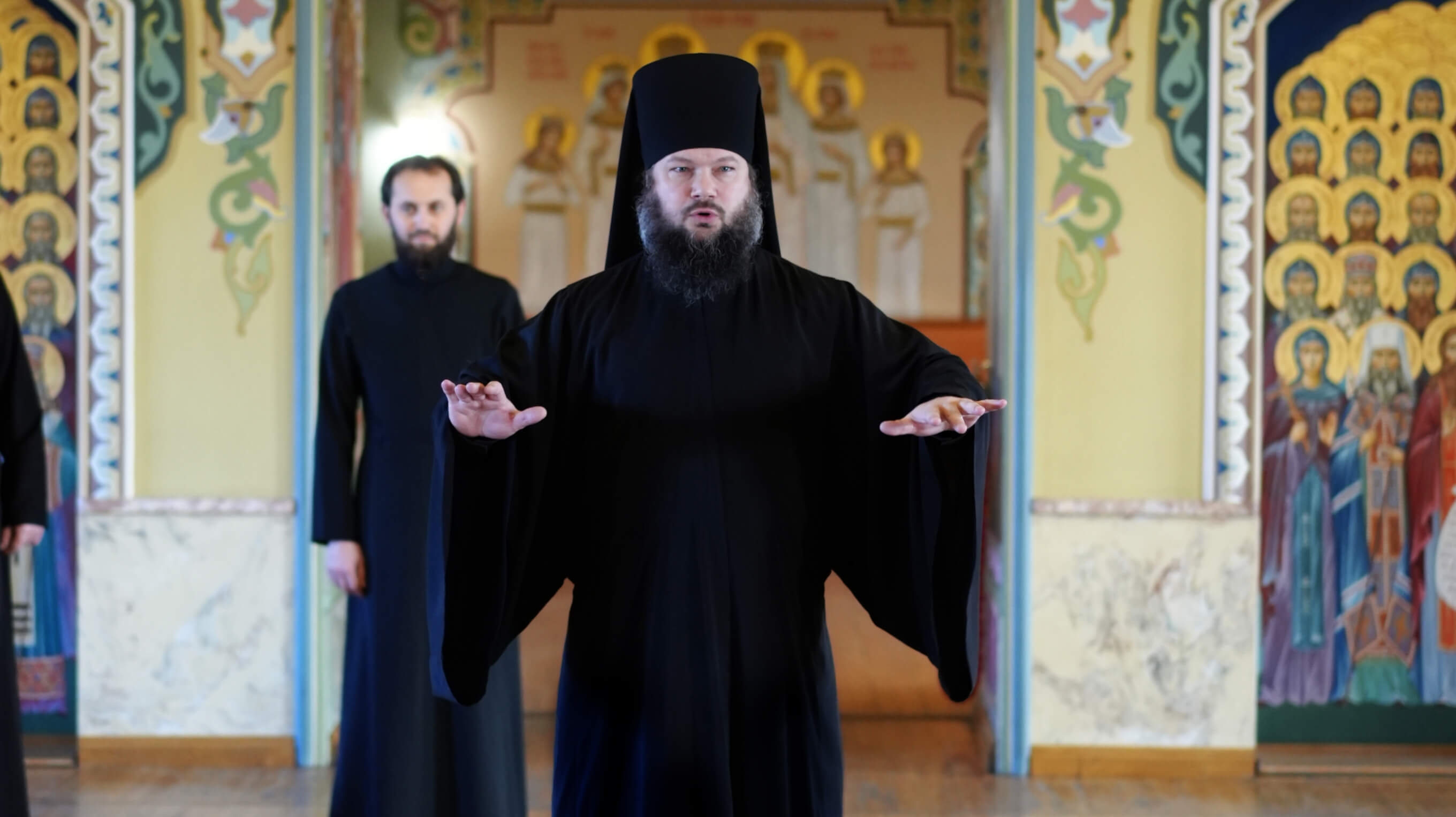
Father Simon, tell us briefly about how you came to know church music.
— I grew up in a family where everyone, in one way or another, was connected with singing. My parents, my grandmothers, my grandfathers… Some sang in a church choir, some in folk choral groups. Both my grandfathers played instruments: the cimbalom and the violin. So music surrounded me from earliest childhood, church music included. And I did not merely hear it, I tried to sing it. My first serious experience was the children's choir at St Nicholas Cathedral in Chernivtsi. I was about six or seven then. My parents took me there. And I liked it very much, because there were a great many children there: about fifty or so. And the first thing we learned there was "Воскресение Христово видевше" and "Богородице Дево радуйся". Then we learned to sing the akathist to a chant melody. And little by little they began to draw us into the services: partly with the older singers, partly on our own. All of us were directed by Alla Vasylivna Horiuk, then still quite a young girl, who worked with us practically every day and took her task very seriously. Now she is already the nun Ioanna, a resident of the Convent of the Presentation of the Theotokos. And the dawn of my awareness of music and of musical understanding came closer to the age of ten, to which my studies at the music school largely contributed.
— And when did you find yourself in an adult choir?
— It was just in '90, when the Holy Spirit Cathedral was given back, that we were all transferred there. And there I began to sing on the left kliros with the adults. I was 11–12 then. And I was the only child there. And by the age of fourteen, when my voice broke from tenor to bass, Father Vasylii Zapotichnyi invited me into the bishop's choir, the principal choir of our cathedral. I remember that the preparation for the Nativity was just then under way. We were learning Bortniansky's hymns and Vedel's canon.
— And where did you learn to conduct?
— At first in the family. Yes, we had a family singing group of that kind, all eight of us: my father, my mother, my sisters, my brothers. We took part in various singing competitions, we were invited to New Year and Christmas children's parties and, naturally, to patronal feasts. Besides that, for a certain period I was the chief precentor of our youth choir. It was a sort of "select team" of enterprising young people. Some came from the kliros, some from the children's choir, some from the bishop's choir. About 20 people in all. We were constantly invited to various events. Especially in the summer. And all of us found it interesting. To travel somewhere, to learn something new, to sing beautifully something people had not heard. Mostly these were trips out to some parish. Sometimes we did weddings.
— Weddings!?
— Yes, in Bukovina there is a tradition of Orthodox weddings without alcohol, without instrumental music, without dancing, with choral music only. In the past it was especially popular. Psalms were sung, spiritual cants, various folk songs and, naturally, church ones. The songs alternated with sermons by the priests. And so it went on until late in the evening. Such weddings still exist. But there are very few of them now.
— How unusual! And still, can you recall the moment when you first came into contact with the melody of the Lavra chant?
— Yes, in the bishop's choir Father Vasylii regularly included some Lavra pieces in the repertoire. "Блажен муж", in particular, was very popular. It seemed very difficult to us then. In general, all the classical pieces are somehow comprehensible in their harmony and their logic. But the hymns of the Kyiv-Pechersk Lavra, in themselves, are very particular, and they simply will not go into your head just like that. They had to be studied for a long time in order to understand them, to feel them and to sing them rightly.
— Can you explain what the difference is, why it is so?
— Because this is a different style, a different stylistic colouring, a different order of chord movement altogether, a different sense of music. Music, after all, has its own picture. It is not for nothing that people say a piece has a harmonic and dynamic design of its own. But in the Lavra melody there is none of that. In the Lavra chant it is as though everything goes by inspiration. Some note could simply appear on the move that is very hard to hit. For me it was sheer fantasy, to be honest. I simply could not understand how to sing these notes that stand before you. But all of it was interesting. And the harder it was, the more interesting I found it.
— And was there anything harder than the Lavra singing?
— Well, there were the difficult concertos of Chesnokov or of Bortniansky. They were difficult in their own way, because they have a different feeling for music. Their music is as though theatrical rather than church music. It has a great many accidentals, sharps and flats, what are called "the black keys". It was simply awkward. But Lavra music is difficult in its own way.
— What did you think about the Lavra itself, how did it appear to you then?
— For us it was something distant, lofty, even heavenly. A place where the people had a super-culture of their own, incomprehensible to anyone, and a chant of their own. And so the hymns themselves also seemed to us far from simple. And when it fell to us to perform something from the Lavra, for instance "Взбранной воеводе" — one of the most popular pieces in Bukovina, by the way — or "Блажен муж", there was a feeling that at last we had touched something real. And for me the Lavra was always out of reach. I did not believe I would ever get here.
— And what happened when you did find yourself here?
— My first impression was that I had not thought they would take me onto the kliros at all. It seemed to me that this was a closed subject for me, that it was only for the chosen. I remember coming into the Refectory Church; the brethren were singing at vespers, all in black mantles. I listened and marvelled at how they were singing it — how could that be? And of course everything sounded different from the way it did with us. In Chernivtsi we tried to keep all the rules of music. But here there were rules of their own, after all.
— Rather, no rules at all (smiles).
— You could put it that way. But here both the approach to singing and the singing itself were completely different. On the one hand, once you get used to it you understand that it is easier that way. But earlier it seemed something incredible. We had also been told that the brethren sing some very difficult hymns by heart. So it seemed to me that they were all specialists there. Yes, of course, I heard that sometimes they did not sing quite cleanly, that somewhere they slid off. All sorts of things happened. But on the whole it was something grand for me.
— And now, what will you say?
— Even now precentors I know tell me that these are very difficult hymns. And my own view is that these hymns really are unusual. I am still studying them, and in many ways they are still a riddle to me. In places I criticise certain passages. We even argue on the kliros with some of the brethren, we talk over various chords. To this day we find it interesting why it is this way and why it is that.
— And which piece of the Lavra obikhod did you like best then, and which one now?
— Then… to be honest, I was very fond precisely of "Взбранной воеводе". In the family we always sang it as a concert piece, without hurrying. Then I became taken with the akathist melodies: the exapostilarion "Апостоли от конец" and, of course, "В молитвах неусыпающую Богородицу". And now I would probably name the antiphons at matins as my favourite. Plus "На реках Вавилонских", if it is performed very delicately and carefully. I am also struck by passages of the Cherubic Hymn which is reckoned "the lesser" one, or "the cave" one, as it is also called. Above all it amazes me by its style, and it really was not very easy to learn at first; it was hard to catch its tempo and its character.
— You spoke of arguments; does it not seem to you that the master's hand did not quite reach the whole of the Lavra obikhod. Take the antiphons of the 4th tone. There is a wholly extraordinary opening, "От юности моея", and then after the third part comes mediocrity, vagueness, a kind of greyness, compared with that most excellent opening.
— Yes, the continuation of "От юности моея" is as though out of a different opera. The style there is somewhat different. But in the other antiphons too, if you look, you can find beautiful passages of their own, in the fifth tone for instance. But I agree, there is little of that. And in general the Lavra obikhod as a whole is very uneven. There are places in it that are simply divine, to which nothing can be added and nothing taken away. And there are less happy ones — take the irmoi. Not all of them, but with most of them something is clearly wrong, as though they had been forgotten. Though taking it as a whole, all these less happy passages pale beside a single Lavra "Славословие", so to speak, or "Честнейшая". And when you come home after the service, it is the echoes of precisely these wonderful melodies that stay in your head.
— In your view, how did this come about, why is not everything so flawless?
— Evidently they did not manage to bring everything to perfection. For all that beauty and exceptional quality of the Lavra chant for which we value it so highly appeared only in the nineteenth century. Orthodox music at that time, as is well known, went on experiencing Italian influence. Through composers such as Bortniansky, for example, new music and a new style were being poured in. It was precisely in that period that additional parts with a beautiful deep bass began to appear above the basic Lavra melody, whose roots go back into the ancient znamenny chant. In general, the dynamic bass part is a special charm of the Lavra chant. Such a melodic bass is rarely met with in church music. I will not undertake to assert who exactly stands behind these artistic embellishments. Many harmonisers of the Lavra chants are known: Archimandrite Flavian (Prykhodko), and Malashkin, and Fateyev, and Benevsky, and many others. But they rather only corrected the melodic line, whereas to create those famous masterpieces of ours a quite different scale of genius was needed, comparable only with Vedel. So I shall venture to suppose that behind all the best that we have stands not a collective beginning or a popular tradition, as it used to be thought, but some outstanding personality. Otherwise the whole Lavra obikhod would be flawless, like all the music of Bach, for instance.
— And are there things you would like to change or to correct in the Lavra obikhod? And is it worth taking up such a correction at all?
— Correcting the harmony is a technical matter; by and large it does not change the picture. But if you lay claim to something real, so that all the irmoi sound like our zadostoiniki, then here you cannot do without outstanding talents. And they, as we know, do not march in formation. You cannot make them appear here and now. So if we are to perfect anything, it is only the technique of performance.
— As to performance: there are lovers of loud-voiced singing and, on the contrary, of quiet, heartfelt singing. Which of them should one follow more?
— Everything must have its proper place. For reverent, prayerful, quiet standing before God there are vespers, compline and part of matins. In the end, in one's cell one can pray with weeping in silence, in hesychia. As Christ also says: "enter into thy closet, and when thou hast shut thy door, pray to thy Father". (Matt. 6:6, King James Version). But the polyeleos of matins and, still more, the Liturgy itself are a feast, when one should rejoice and be glad the more. For this is a drawing near to the reality of the Kingdom of God, this is already "the New Life". And here, of course, a powerful and, I would even say, somewhat dramatic performance is more than fitting.
— And what is to be done with those who like to drag the singing out endlessly, or, on the contrary, with those who hurry excessively, as though afraid of being late for something?
— On the one hand, there is a notion, a monastic one rather, that everything should be unhurried, drawn out as it were, penitential. Take those recordings of Lavra singing from the beginning of the last century. They are very slow-moving. And the service itself went on longer then. The all-night vigil could last six hours and even more. But one must understand that the general tempo of life was different then: quiet, drawn out like that, nothing like today's time, which is forever striving somewhere. And the musical literacy of the singers… Where, in those days, was such a number of monks acquainted with musical notation to come from, when far from all of them could even read? Besides, when a large choir sings it is in any case more unwieldy than a small one. Forty men are such a bulk that it is not so easy to get it moving. And the main point is the vision of the precentor himself. The precentor sets the tempo and the style. If the precentor himself is heavy-going, then the choir sings heavily. The precentor hurries and the choir hurries. So here, of course, one has to find the golden mean. On the whole one may say that it is better now to aim at somewhat quieter singing, because at great speed very many of us do not pronounce the words, and the hymn turns into "a mush", which is impermissible in a professional choir.
— And might it not turn out that for the sake of the words we lose the melody, which perhaps underlines the spirit of the service even more than the words do. In general, in your view, what should have priority: the words or the melody?
— It is hard to say. For there is prayer with the understanding, what the Apostle Paul calls "to sing with the understanding", that is, to sing in such a way that everyone can make out what is being sung. And there is prayer with the spirit: "to sing with the spirit" (1 Cor 14:15, King James Version), that is, an address not to the mind but rather to the heart. It is precisely the echoes of this prayer with the spirit that the melody preserves in itself. It is a kind of surge of the heart towards God, when one wants to sing more than to pronounce words to the singing. In any case, one must hone one's craft, one must work at it. The Lavra singing is brisk, it is dynamic. Of course there are individual passages in it, but on the whole it is more vigorous singing. And this vigour in it is underlined further by the fact that there is a great deal of the major key here. And even the minor, if it is performed correctly, also sounds very vigorous and beautiful, almost like the major. But one should not drive it too hard. It needs to be done somehow with more "pulling back", more carefully, while keeping the vigour. This has to be worked at.
— Do you not have the feeling that the Lavra singing is somewhat underrated. That it is still little known, that in the world of music the Kyiv-Pechersk chant has not yet shown itself, that it is still half asleep or half in shadow?
— Yes. I do have that feeling. In the first place, the scores are still inaccessible to many, especially those of Great Lent. Few have seen these books and few know about them. Or the set of our "podobni", in places quite astonishing, is likewise practically impossible to find. Though in our technological age there should seem to be no problem with that at all. I say nothing of video recordings. At least in audio form, so that many could listen to how the Lavra chant sounds and understand how one must work with it. For it is fully worthy of adding to the treasury of music on a world scale. But these are dreams aloud, rather than anything else.
— We are sincerely grateful to you. And in conclusion we should like to ask: what gives you the greatest joy in life? What would you find it hard to live without?
— I would say that it is my monasticism. Yes, the fact that I am a monk. The very life in the monastery. It has become my own, the thing that warms both soul and heart. And I am extraordinarily glad of it


Comments