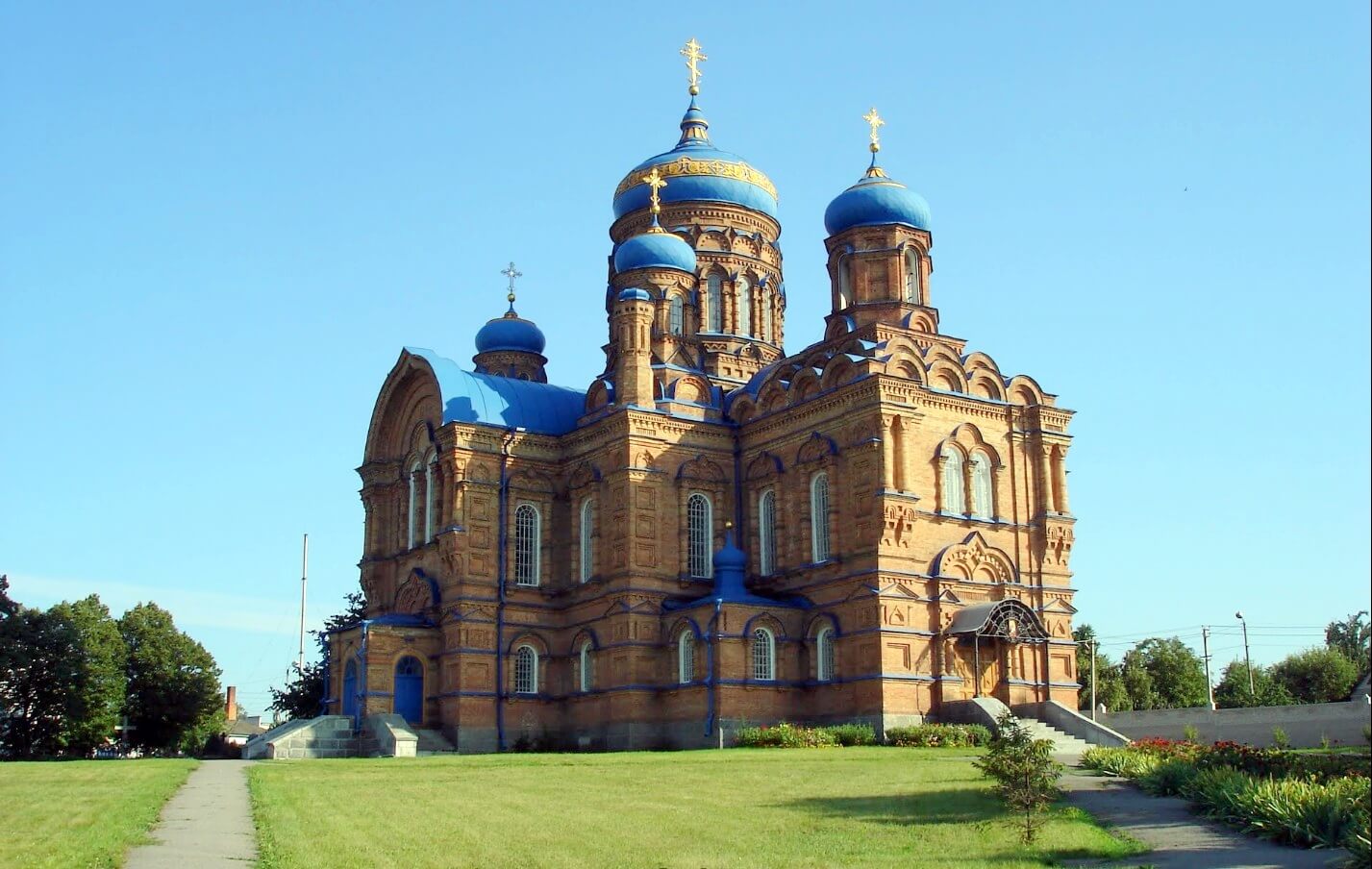
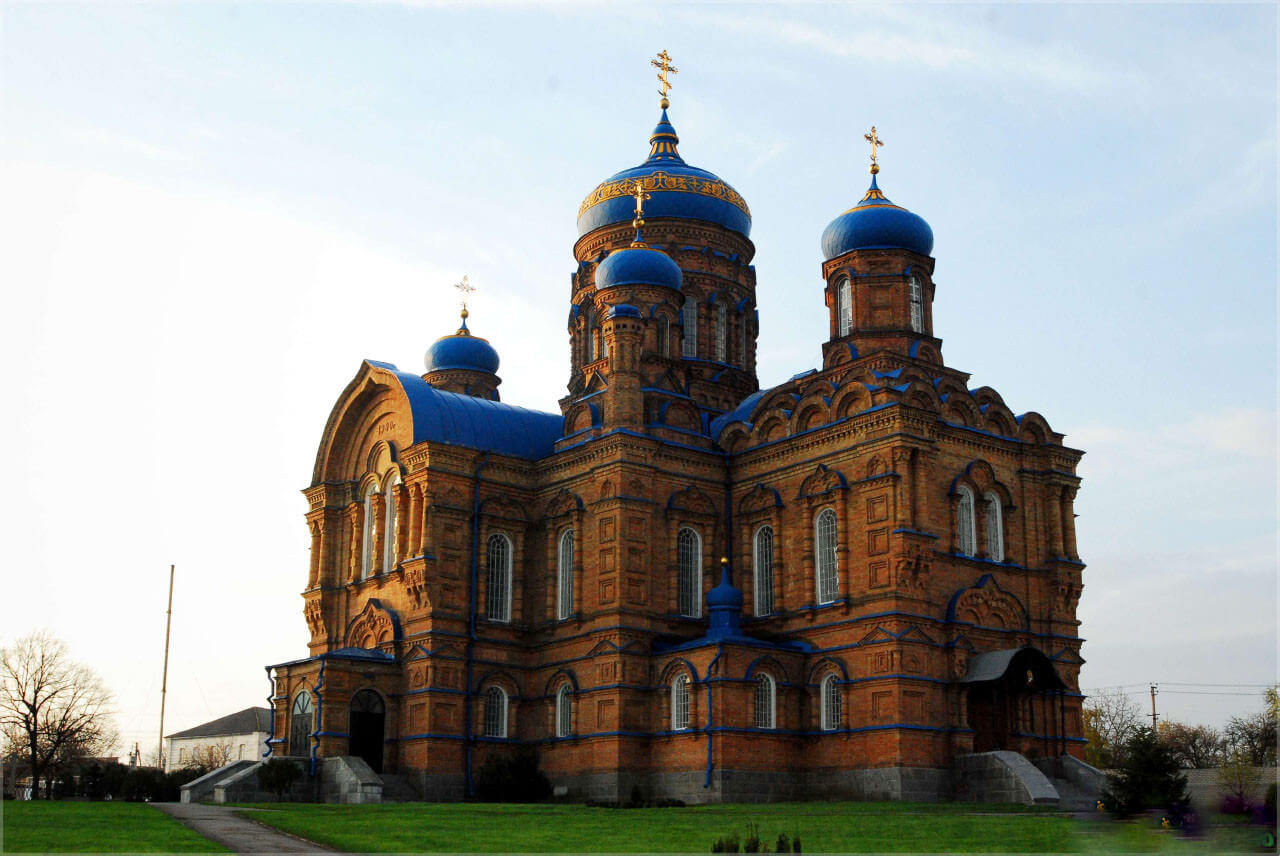
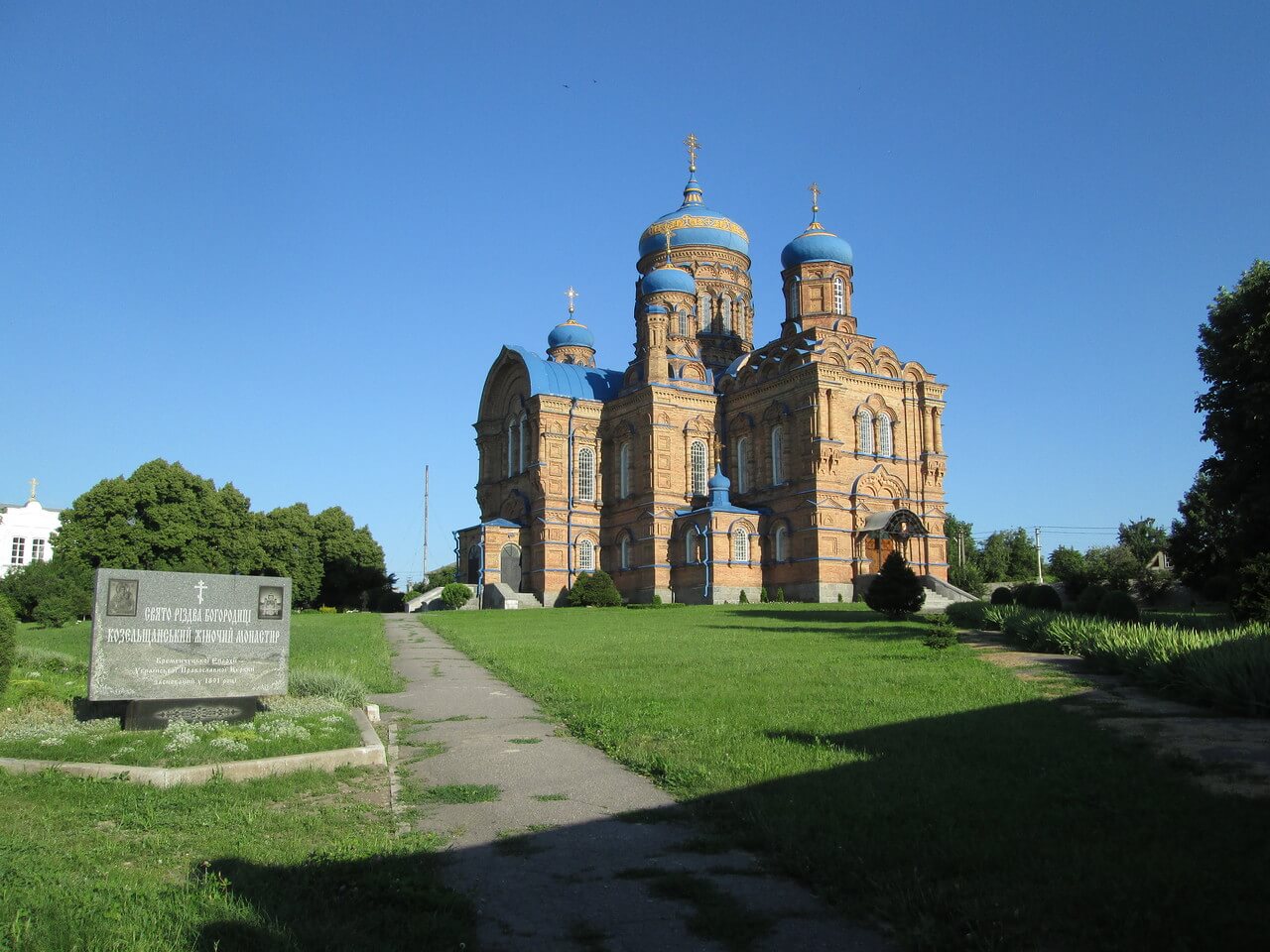
Kozelschyna Nativity of the Most Holy Mother of God Convent
49.215401, 33.852478
- the document of appointment to the post:
Journal No. 19 session of the Holy Synod of UOC on 26.07.2005 year
The Nativity of the Theotokos Convent of Kozelshchyna, of the Kremenchuk eparchy of the Ukrainian Orthodox Church, stands in the town of Kozelshchyna in the Poltava region. Kozelshchyna itself is linked with the Cossack officer family of the Kozelskys: by one account it was founded in the first quarter of the 17th century, by another by the Kobeliaky company commander Pavlo Kozelsky in the first quarter of the 18th1. The last of that family to hold Kozelshchyna was Pavlo Kozelsky († 1879), marshal of the nobility of the Kobeliaky district, who bequeathed the estate to Sofiia Kapnist, daughter of the mathematician Mykhailo Ostrohradsky and wife of Count Volodymyr Kapnist1.
The family shrine of the Kapnists was an icon of the Most Holy Theotokos. Count Volodymyr Kapnist noted in his own notebook: "This icon in my family, and in the neighbourhood too, has long enjoyed a reputation for miracles"4. An old printed description preserves the Kozelskys' family recollection that the image belonged to the wife of the Zaporozhian regimental scribe Siromakha, and that the painting of the icon recalls the Italian school4.
Early in 1880 the Kapnists' fifteen-year-old daughter Mariia, a pupil at the Poltava Institute for Noble Maidens, fell gravely ill: both her legs began to twist and were set in plaster1. Neither the plaster casts of the Kharkiv doctors, nor the Caucasus mineral springs, nor a journey to Moscow, where Mykola Sklifosovsky took part in her treatment, changed anything; the doctors advised turning to the French neurologist Jean-Martin Charcot1. On 21 February 1881, the day her father sent a telegram summoning her to Moscow for an examination, Mariia was healed before the family icon. By her own account her mother brought her the image with the words: "Masha, here is our family image. And in our family there lives a tradition: if one of the sick venerates the image and cleans it, that person will certainly recover"; after praying before the icon a sharp pain in her spine took away her senses, and when she came round she felt that the use of her legs had returned1. The journey to Moscow took on a new meaning - to have the healing attested by the very doctors who had been treating her1. All of this fell in the first days of March 1881, when Emperor Alexander II was killed, and the count recalled that, despite the horror that gripped everyone, what many had seen before the icon helped them through those days1.
At the end of March 1881 the Kapnists returned to Kozelshchyna, and pilgrims began to come. In April the count raised a chapel in his garden and on the 23rd of that month moved the image into it; molebens were served before the icon, and donations for building a church came into the collection box1. News of further healings reached the count so often that on 4 July 1881 a special commission came to Kozelshchyna for the first time to verify them1. On 8 September 1881 a wooden church of the Nativity of the Most Holy Theotokos was laid on a hill a quarter of a verst from the chapel and consecrated on 7 September 1882, with the chapel of St Mary Magdalene consecrated on 9 September; in 1883 quarters for the clergy, winter quarters for pilgrims, a hospital and a pharmacy were built beside the church1.
On 1 March 1885 a women's community of monastic type was established at the church, its members appointed as twenty novices under the nun Olympiada from the Zolotonosha convent1. The sisters arrived at Kozelshchyna on 6 April 1886, the wonderworking image was carried from the chapel into the church on 3 June, and the community was solemnly opened on 4 June1. On 22 July 1887 a large cell block with a heated church was laid; a hostel for poor pilgrims and a clergy house were built the same year; and in 1888 a school of icon painting for gifted sisters was opened, together with two parish schools - a one-class boys' school and a two-class girls' school with a hostel for thirty girls, of whom twenty orphans were kept entirely at the community's expense1. On 21 October 1890 the left chapel of the heated church, dedicated to the holy martyr Elisabeth, was consecrated1.
Between late October 1890 and January 1891 the government considered and approved the plan to turn the community into a monastery: by then it numbered more than a hundred sisters and held Count Kapnist's endowment of 50 000 roubles together with the land his family had given for the grounds and the farm1. The celebrations took place on 15—18 February 1891, and on 16 February the right chapel of the heated church was consecrated1. Abbess Ahniia enlarged the girls' parish school to ninety pupils and its hostel to sixty places, built a guest house, a stone clergy house and further cell blocks, and in 1894 opened the convent's brickworks1. After her death the house was governed by Abbess Olympiada (1896—1915), formerly the first head of the community (1885—1889) and superior of the Zolotonosha convent (1890—1896); she added joinery to the boys' school curriculum in 1906 and laid on a water supply for the convent1.
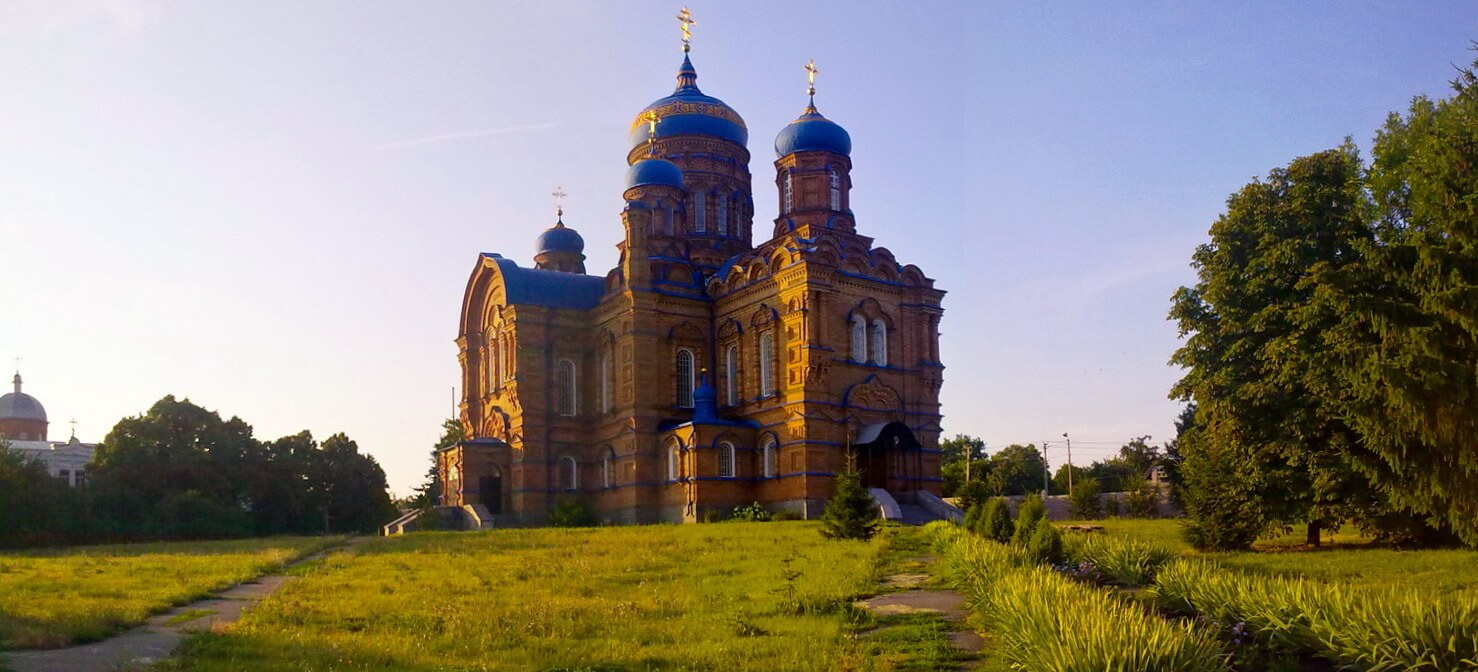
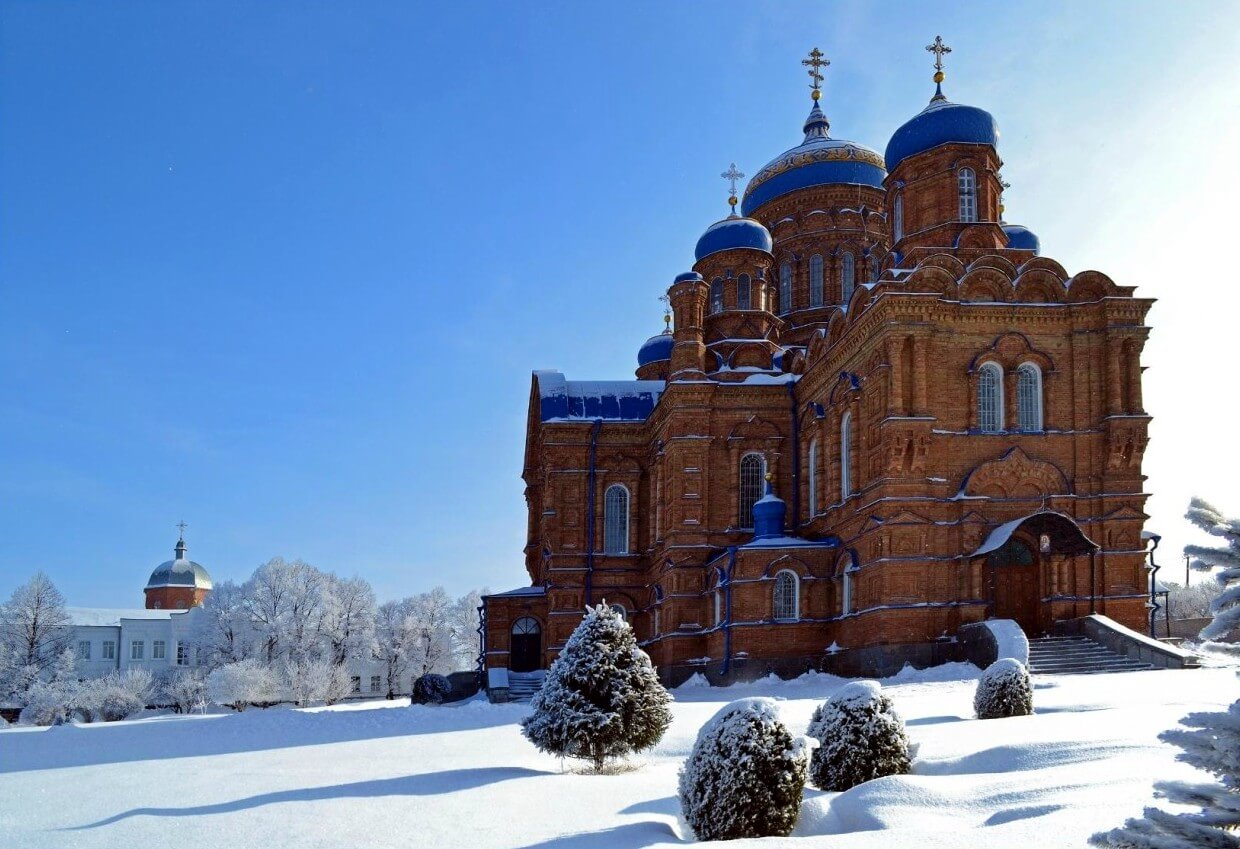
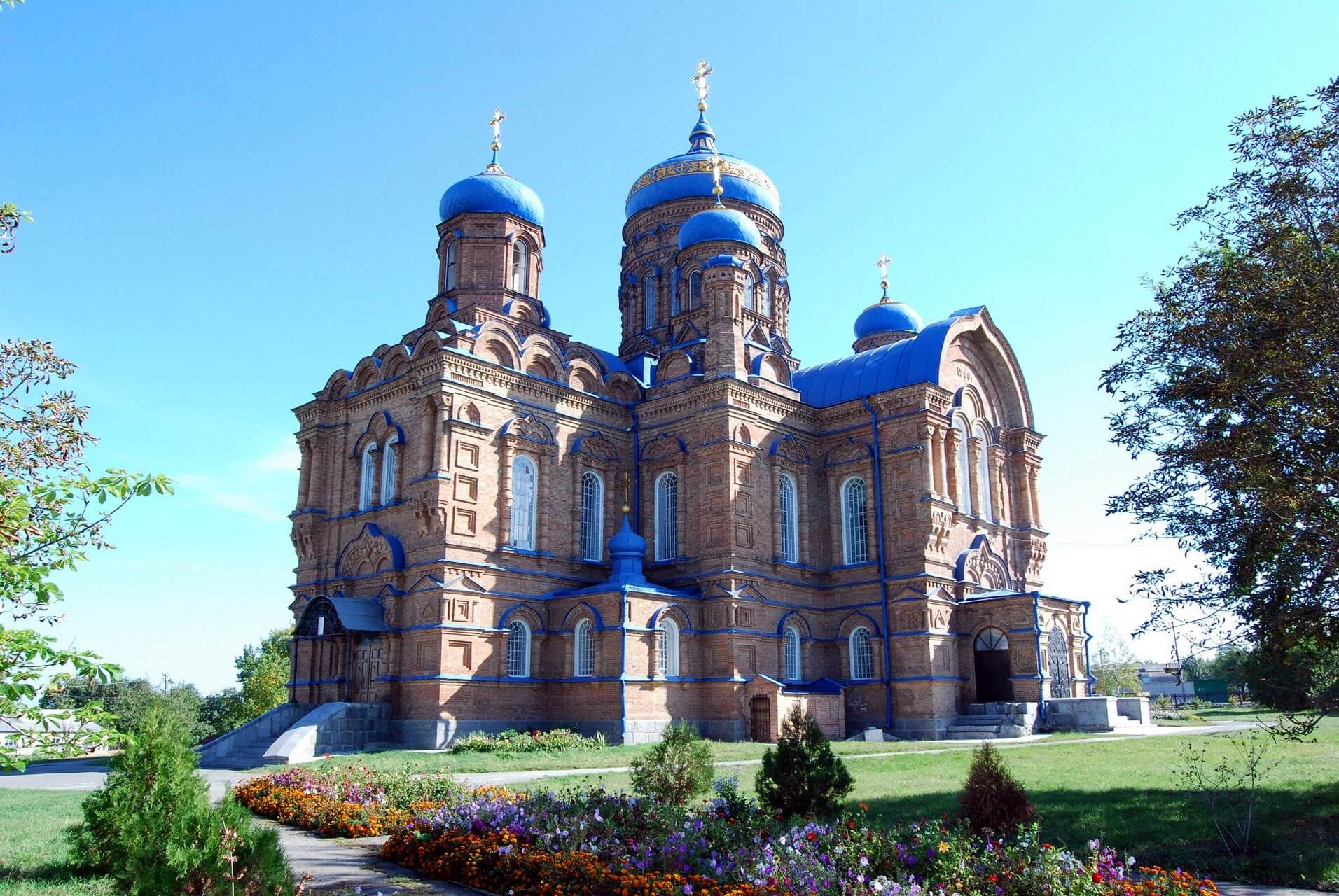
The wooden church was replaced by a stone cathedral of the Nativity of the Most Holy Theotokos, laid on 10 October 1900 to the south of the first church, which was dismantled during the works, and consecrated on 23—24 July 1906 once the finishing was done1, 2. The cathedral was built to the design of the Poltava eparchial architect Serhii Nosov; cruciform in plan, it is crowned with seven onion-shaped cupolas, one of which carries a belfry in its drum on the western arm of the cross2. The red-brick masonry is rich in decorative window surrounds, string courses and niches on the facades, while the church's chief peculiarity is its vaulting without columns, achieved by a special system of arches at a length of 37 metres, a width of 30.5 metres and a height of 38 metres to the cross of the main cupola2. Before the revolution the interior held an iconostasis of white marble with inlays of green Brazilian onyx from the Menzione workshop, and the decoration of the interior was directed by the Kyiv artist Mykola Murashko2.
In 1904 Emperor Nicholas II visited the convent1. During the war of 1904—1905 and at the beginning of the First World War the convent opened a military hospital on its grounds - of ten and of forty beds respectively1. In 1917 the first unauthorised seizures of convent land took place, and the household suffered heavily in the civil war of 1918—19201. Mariia Kapnist's own life was no less dramatic: her second husband, the geologist and public figure Petro Armashevsky, was shot in 1919, the widow sought refuge in Odesa and departed to God in 1921 - and it was Archpriest Oleksandr Vvedensky, who cared for her and buried her, who wrote down the memoirs from which her own account of the healing is known1.
In 1929 the convent was closed and its buildings handed to secular institutions; monastic life continued until 1932 at the convent's skete in the village of Obytok near Kremenchuk1. The convent's spiritual father was Archimandrite Oleksandr (Petrovsky), hieromartyr and later Archbishop of Kharkiv († 1940)1. Abbess Olympiada II (Verbetska), who had settled secretly in Poltava, was given up to the authorities and tortured to death in the city prison in 19381. On 18 April 2008 the Holy Synod of the Ukrainian Orthodox Church blessed the local glorification and veneration of Abbess Olympiada (Verbetska), approved the iconographic image of the saint and the drafts of her troparion and kontakion, and ruled that her memory be kept on the day of her martyrdom - 20 May / 2 June6. Her relics were found in that same year, 20087.
The wonderworking image had a history of its own: in 1929 the nuns secretly carried the icon to the skete in Obytok; after that skete was closed in 1932 it was kept quietly in Kobeliaky; in 1941—1949 it was again at Kozelshchyna; then at the Lebedyn convent in the Cherkasy region; from 1961 in a Kyiv flat belonging to former Kozelshchyna sisters; and on 23 February 1993 it returned to Kozelshchyna4.
After the convent's closure the cathedral was used as a theatre and its furnishings were gradually lost, and before the war prisoners were held there2. In August 1941 Soviet military units occupied the cathedral, and the occupiers afterwards placed their headquarters in it, but - by the convent's own account - they left the church after the repeated appearance there at night of a woman's figure in black clothing, and allowed the convent to reopen2. After the second closure the cathedral was used as a club and then for farm purposes2. The Ukrainian writer Oles Honchar (1918—1995), a native of the village of Sukhe near Kozelshchyna, mentioned this church in his novel "Tvoia zoria": "And Kozelsk opens up from here already with its brick buildings and the cupola of the district club, whose architecture is like St Peter's basilica in Rome"2.
In 1941—1949 the Kozelshchyna convent was revived for a time under Abbess Feofaniia (Zonova)1. Early in 1990 the convent's cathedral was handed to the parish community, and on 6 March of that year, the feast of the Kozelshchyna icon, the first service since the church's closure was celebrated there1. In 1992 the surviving Kozelshchyna sisters were invited back to their own house and the parish community was turned into a convent under Abbess Iraida (Kravtsova), who laboured much for its revival and departed to God on 22 June 19961. The cathedral was under restoration from 1992, and services resumed in it in 19982.
On 14 November 2007 the Holy Synod of the Ukrainian Orthodox Church created the Kremenchuk eparchy, separating it from the Poltava eparchy, and assigned to it the Kozelshchyna district in which the convent stands5. On 22 May 2018, the feast of the translation of the relics of St Nicholas, His Beatitude Onufriy, Metropolitan of Kyiv and All Ukraine, led the Divine Liturgy at the convent, followed by a procession; the tenth anniversary of the finding of the relics of the venerable martyr Olympiada was marked at the convent that day as well7. Today the services of the convent's principal feasts are led by Metropolitan Mykolai of Kremenchuk and Lubny: on 6 March, the day the Kozelshchyna icon of the Mother of God is honoured, a procession is made with the wonderworking image8, and on 2 June the whole eparchy prays on the day of the venerable martyr Olympiada (Verbetska)9.
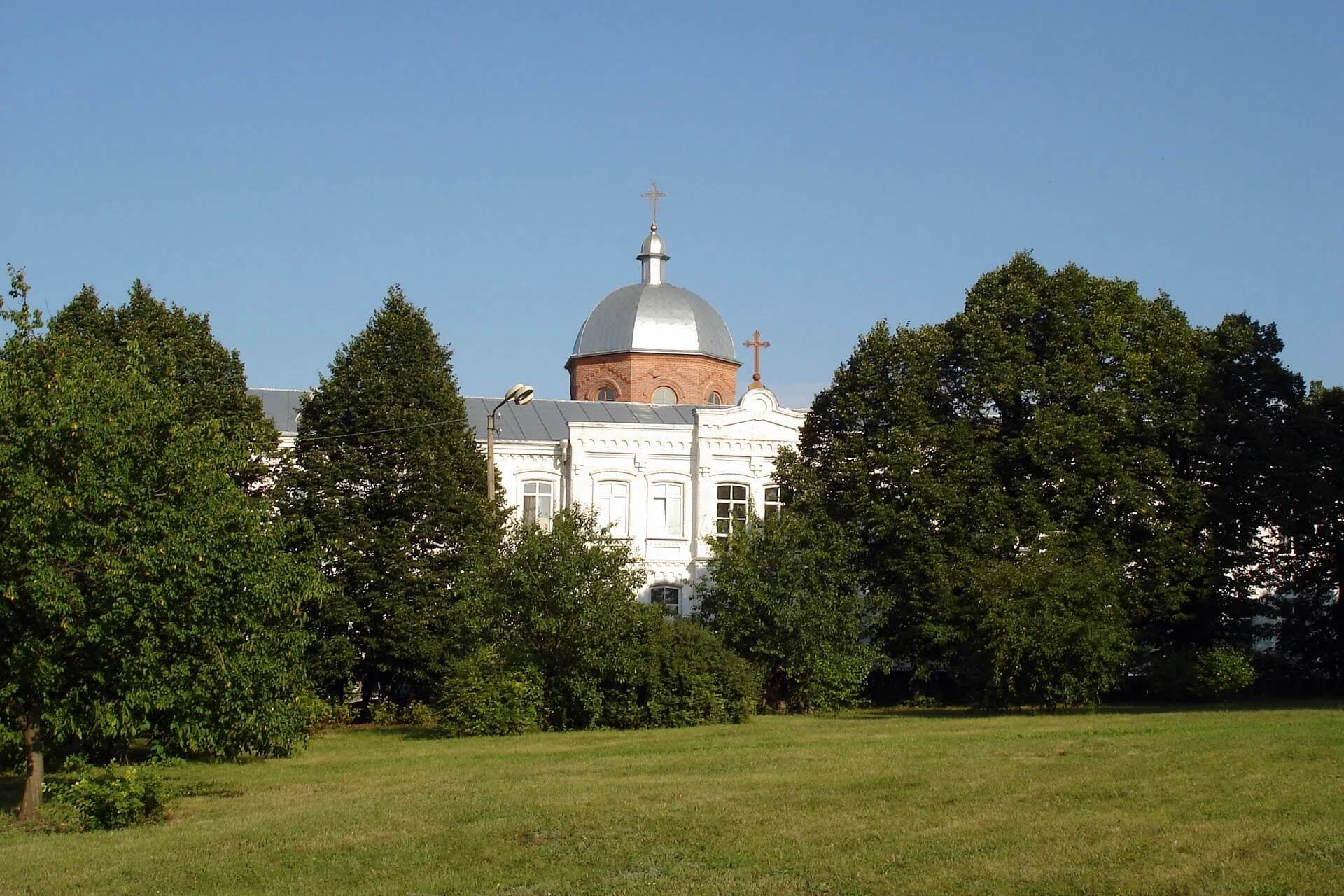
The most conspicuous building after the cathedral is the two-storey cell block with the heated church of the Transfiguration, raised in 1887—1890 thirty-five metres to the north-east of the cathedral; the church adjoins the centre of the block's eastern facade, and its main body forms an equal-armed cross in plan2. The patronal feasts kept here are the Transfiguration of the Lord on 6 (19) August, the Nativity of the Most Holy Theotokos on 8 (21) September, the feast of the Kozelshchyna icon of the Mother of God on 21 February (6 March) and the memory of the venerable martyr Olympiada (Verbetska) on 20 May (2 June)3.
Show sources
- 1. «Исторические сведения» (official site). Різдва Богородиці Козельщинський жіночий монастир (accessed: 2026-08-21)
- 2. «Архитектура» (official site). Різдва Богородиці Козельщинський жіночий монастир (accessed: 2026-08-21)
- 3. «Праздники» (official site). Різдва Богородиці Козельщинський жіночий монастир (accessed: 2026-08-21)
- 4. «Святыни» (official site). Різдва Богородиці Козельщинський жіночий монастир (accessed: 2026-08-21)
- 5. «Засідання 14 листопада 2007 року (журнал № 109)» (church document). Священний Синод Української Православної Церкви (sinod.church.ua), 2007 (accessed: 2026-08-21)
- 6. «Засідання 18 квітня 2008 року (журнал № 28)» (church document). Священний Синод Української Православної Церкви (sinod.church.ua), 2008 (accessed: 2026-08-21)
- 7. «Блаженніший Митрополит Онуфрій очолив святкове богослужіння у Козельщинському монастирі» (UOC news). Синодальний інформаційно-просвітницький відділ Української Православної Церкви, 2018 (accessed: 2026-08-21)
- 8. «Козельщина. Молитовно відзначили свято Козельщанської ікони Божої Матері» (eparchy website). Кременчуцька єпархія Української Православної Церкви, 2026 (accessed: 2026-08-21)
- 9. «Козельщина. День пам'яті святої преподобномучениці Олімпіади» (eparchy website). Кременчуцька єпархія Української Православної Церкви, 2026 (accessed: 2026-08-21)
- Journal No. 19 session of the Holy Synod of UOC on 26.07.2005 year
- Journal No. 14 session of the Holy Synod of UOC on 08.12.1992 year