Holy Dormition Convent
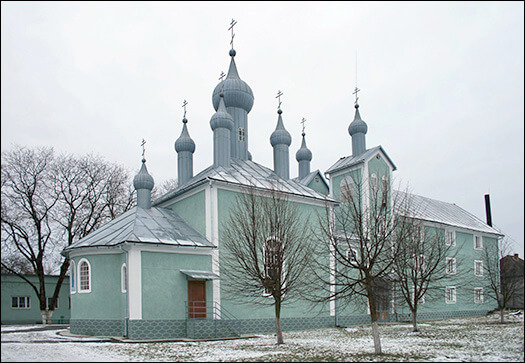
48.462038, 22.542345
- the document of appointment to the post:
Journal No. 27 session of the Holy Synod of UOC on 25.09.2023 year
The Dormition convent stands in the village of Domboky, Mukachevo district, in Zakarpattia1.
The idea of founding a monastery at Domboky arose among the people of the surrounding villages as early as the 1920s, and its chief mover was father Ivan Karbovanets, the parish priest of neighbouring Chervenovo1. In 1930 he and his parents sold to the state all their property in the village of Nevytske near Uzhhorod for 114 thousand Czech crowns, and resolved to put the money into building an Orthodox monastery1. Just then an agricultural school at Domboky had closed and a whole complex of buildings stood empty that suited a monastery perfectly - and the state sold that estate to Karbovanets for 125 thousand Czech crowns1. Having bought the place, father Ivan at once set up an Orthodox cross there and wrote to the eparchial administration of his intention to give the land and its buildings for a monastery1.
On 11 April 1930 Archimandrite Alexiy (Kabaliuk) answered him in the name of the ruling bishop: "The eparchial administration long ago gave its agreement in principle to the building of a convent at Domboky, but it is necessary that you, as the owner of that estate, should tell us whether you are indeed giving something for a convent or not, and if you are, on what terms. Only after that will the eparchial administration be able to send you several nuns to organise it"1. Karbovanets handed over everything he had bought to the eparchy on condition that it undertake the founding of the monastery, and when a new bishop, Yosyf, arrived in the middle of 1930 the gift was accepted1. The organising of the convent was entrusted to Archimandrite Alexiy1.
The newspaper "Russkaya Zemlya" wrote on 23 November 1932: "Father Ioann Karbovanets's efforts have ended in success. At Domboky a monastery has been founded on a plot of seven yokes of land. The rebuilding of the church has begun these days. A cupola in the Russian style has already been built. On 4 December they plan to raise the cross onto the cupola of the church"1. This is one of the first notices of the founding in the press of the day1.
The major repair and restoration of the buildings was carried out to the drawings of Archpriest Vsevolod Kolomatskyi, who directed all the work; the iconostasis was carved by the master I. Pavlyshynets with his assistant Vasyl Lendel of Rakoshyno, who afterwards made the small altar for the icon of the Mother of God himself and carved a cross1. On 30 August 1931 bishop Yosyf asked abbess Paraskeva (Prokop) at Lypcha for help in organising the life of the house; six sisters decided to move to Domboky, and the newly formed house fell to nun Yevpraksiya to lead1. In 1934 hieromonk Varlaam (Savynets) was appointed priest to help Archimandrite Alexiy, in 1936 the sisters enlarged the altar in the church, and a sewing workshop worked at the house, making priestly vestments to order for the Orthodox clergy1.
On 22 October 1938 the newspaper "Pravoslavnaya Rus" printed a short account of the monastery, describing it thus: "A small block, a garden. Behind it a church with a large stone block, a stable, a small field, a chapel with two graves beside it. The superior Yevpraksiya leads 25 sisters"1. In that same year the icon of the Mother of God "the Swift Hearer", written on Athos, was brought to the monastery from Jerusalem1.
In 1941 the sisters invited nun Liudmyla (Dranko) from the Lypcha monastery to be their superior, but a year and a half later she died1. On 18 June 1942 nun Fevroniia (Ratsiuk) was appointed superior, at the sisters' own request1. In 1942, for the tenth anniversary of the founding, the "Pannonia" press in Mukachevo published father Mykola Shcherbey's booklet "The Lamp of the World", giving the history of the house and its holy things1. In that year the monastery kept three temple feasts: the Annunciation of the Most Holy Mother of God, the Sunday of the Myrrh-bearing Women and the Transfiguration of the Lord1.
In the summer of 1944 the house gave shelter to children who were being taken westward1. By one account a Hungarian officer approached the Russian Red Cross proposing that it take into its care 186 boys and girls between the ages of five and fifteen, and father Ivan Karbovanets together with the nuns arranged their housing at Domboky and Chervenovo1. The oldest girls and some of the small children were taken into the convent: the nuns had sewing machines, and the work was set up like a workshop - dresses and linen were quickly sewn for the girls1. One of those children, Iryna Berkovska, remembered: "Then we found ourselves at Domboky. I remember the convent, where we worked - we husked maize, we threshed sunflowers. The nuns warmed us as with a mother's heart..."1. Many of the children were baptised at the monastery1. Thirty-seven years later, on 24 August 1981, those of them who could be found gathered at Domboky by the chapel of father Ivan Karbovanets, to bow to him and thank him for the mercy shown in those hard years1.
The last years of his life were spent at Domboky by Archimandrite Alexiy (Kabaliuk), the spiritual father of the house1. Shortly before his death, on 20 November 1947, he took the great schema, and on 2 December, the day of his death, he wrote his testament in his own hand, leaving the nuns of Domboky some of his belongings and icons1. From there he was taken to the St Nicholas monastery in the village of Iza, where he was buried on 5 December1, 2.
In 1946 hieromonk Varnava (Shcherban) painted the monastery church1. Before collectivisation the house held twenty-three hectares of land - arable, orchard, kitchen garden, hayfield, vineyard; four workshops worked at it - sewing, tailoring, shoemaking and bookbinding - and every year the nuns made about 700 litres of wine1. On 19 June 1949, the Sunday of All Saints, Archbishop Makariy (Oksiyuk) led the solemn service in the house and raised the superior Fevroniia to the rank of abbess, laying the pectoral cross upon her1. On 24 February 1950 abbess Fevroniia (Ratsiuk) died and was buried in the monastery cemetery1. In the same year nun Paraskeva was chosen superior, and thirty-nine nuns were living in the house1. On 20 September 1951 bishop Ilarion confirmed the monastery's statute, and as the number of sisters had passed fifty, in 1954-1956 they built one block and in 1956 a second1.
The move against the house began in the second half of the 1950s: on 10 June 1957 the regional plenipotentiary wrote to his superiors that the monastery at Domboky should be liquidated1. On 20 July 1959 bishop Varlaam (Borysevych) of Mukachevo and Uzhhorod sent the nuns a letter: the Domboky monastery was being merged with the one at Mukachevo, and by 28 July the sisters were obliged to see to their removal1. The regional authorities decided to hand the buildings over for a boarding school; the iconostasis was taken apart and given to one of the churches of the Mukachevo district, and on 11 October 1959 the boarding school began work1.
The return began in 1990, when on the day of Holy Pascha bishop Yevfymiy (Shutak) visited the boarding school at Domboky and charged nun Valentyna (Voloshyn) with leading the restored house1. On 13 June 1990 the Mukachevo district council, by decision No. 137, permitted the gradual handing over of part of the buildings to the eparchial administration1. On 6 December 1990 bishop Yevfymiy issued a certificate stating that the opening of the monastery at Domboky was blessed by a resolution of the Holy Synod, and on the fifth Sunday of Great Lent in 1991 the bishop served the first service in the restored house1. Abbess Valentyna remembered: "When we came back to Domboky, everything was in ruins; we lodged with one woman. We began to build a chapel"1. On 24 November 1991 a session of the Rakoshyno village council allotted the monastery four hectares of land, and on 2 April 1992 an agreement on joint functioning was concluded between the house and the boarding school1.
On 14 January 2000 abbess Valentyna (Voloshyn) died and was buried in the monastery cemetery1. As early as 28 October 1997 abbess Fevroniia (Tukhlianytsia) had been appointed superior, and by her efforts the painting of the main monastery church of the Dormition of the Mother of God was finished in 2004, carried out by icon painters from Uzhhorod and Velyki Luchky; the iconostases were made by M. V. Rosada of the village of Pryborzhavske, Irshava district1. Three churches stand on the monastery grounds: of the Dormition of the Mother of God, of the Transfiguration of the Lord, and a small house church of the Protection of the Mother of God1.
Two venerated icons of the Mother of God are kept in the Dormition church1. "The Swift Hearer" was written on Athos, in the Greek monastery of Docheiariou, and it still carries an inscription saying that it was made as a gift to the Orthodox of Carpathian Rus; it reached the Russian mission in Jerusalem, where it was seen by schema-hegumen Serapion (Ivanyk), a native of Zakarpattia, who with the blessing of Patriarch Timotheos of Jerusalem brought it to Mukachevo in 1937, and in 1938 the icon was delivered to Domboky1, 3. "The Akathist" icon belonged to Archimandrite Alexiy (Kabaliuk): he received it as a blessing from the superior of the St Panteleimon monastery on Athos, schema-archimandrite Misail, in 19111, 3. Particles of the relics of many saints and a particle of the Life-Giving Cross of the Lord are kept here as well1.
The house keeps the Transfiguration of the Lord on 6 (19) August, the Dormition of the Most Holy Mother of God on 15 (28) August and the Protection of the Most Holy Mother of God on 1 (14) October4. The monastery's patronal feast falls on the third Sunday after Pascha, when the Church honours the memory of the holy Myrrh-bearing Women: on 4 May 2025 the festal Divine Liturgy in the house was led by Metropolitan Feodor of Mukachevo and Uzhhorod, and after the Liturgy there was a solemn cross procession around the monastery6. Separately, on 13 July, the house keeps the day of the transfer of the "Swift Hearer" icon to Zakarpattia: on 13 July 2026, the day of the Synaxis of the glorious and all-praised twelve apostles, the hierarchical service in the monastery was led by Metropolitan Feodor, who at its close, together with the clergy, served a moleben before the wonderworking image5.
Show sources
- 1. Данилець Юрій, кандидат історичних наук. «Нариси історії православного монастиря в с. Домбоки Мукачівського району (сторінка «История и архитектура»)» (official site). Успенський жіночий монастир (с. Домбоки), сайт обителі (domboki-mon.church.ua) (accessed: 2026-08-29)
- 2. «Святые» (official site). Успенський жіночий монастир (с. Домбоки), сайт обителі (domboki-mon.church.ua), 2013 (accessed: 2026-08-29)
- 3. «Святыни» (official site). Успенський жіночий монастир (с. Домбоки), сайт обителі (domboki-mon.church.ua), 2013 (accessed: 2026-08-29)
- 4. «Праздники» (official site). Успенський жіночий монастир (с. Домбоки), сайт обителі (domboki-mon.church.ua) (accessed: 2026-08-29)
- 5. протоієрей Іоан Трикур. «У Домбокському монастирі молитовно вшанували день перенесення ікони «Скоропослушниці» на Закарпаття» (eparchy website). Мукачівська єпархія Української Православної Церкви, m-church.org.ua, 2026 (accessed: 2026-08-29)
- 6. протоієрей Олександр Монич. «Домбоки. Жіноча обитель молитовно вшанувала своє престольне свято» (eparchy website). Мукачівська єпархія Української Православної Церкви, m-church.org.ua, 2025 (accessed: 2026-08-29)
- Journal No. 27 session of the Holy Synod of UOC on 25.09.2023 year
- Journal No. 09 session of the Holy Synod of UOC on 19.06.2014 year
- Journal No. 28 session of the Holy Synod of UOC on 15.03.2013 year
- Journal No. 55 session of the Holy Synod of UOC on 28.10.1997 year
- Journal No. 28 session of the Holy Synod of UOC on 23.11.1990 year
- Journal No. 27 session of the Holy Synod of UOC on 23.11.1990 year
