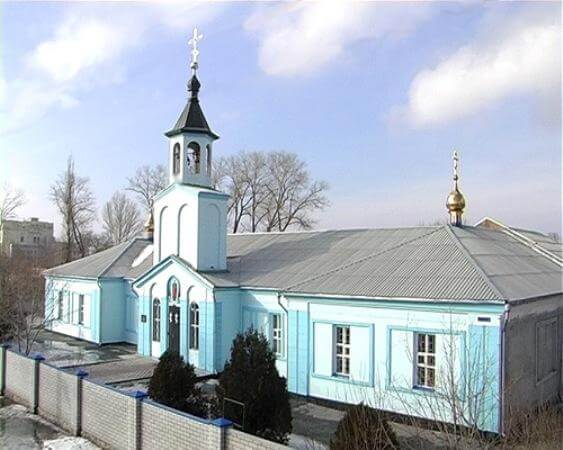
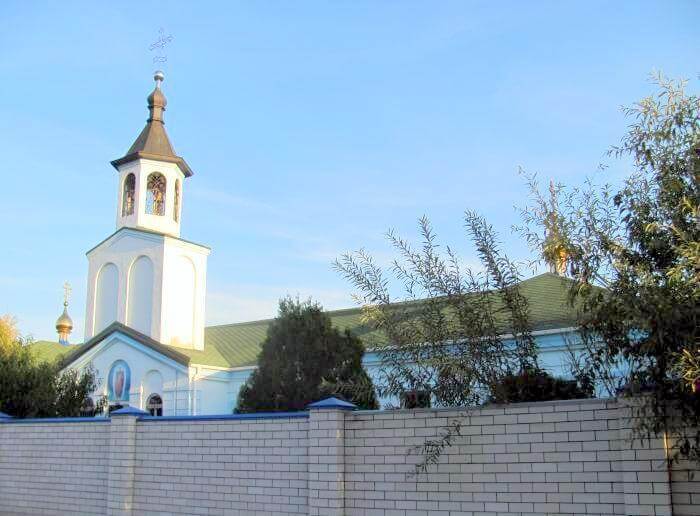
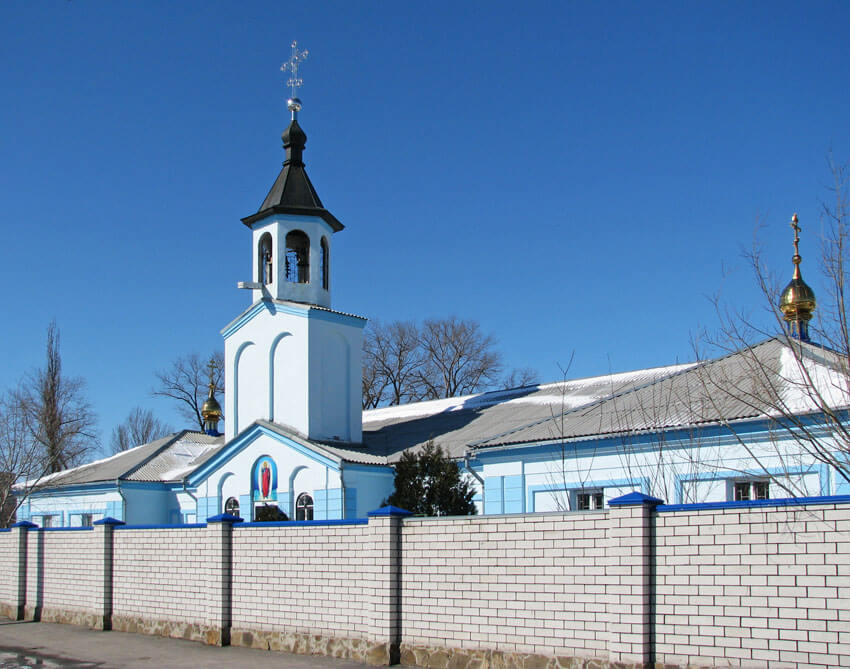
St. Michael the Archangel's Convent
48.899753, 36.310261
- the document of appointment to the post:
Journal No. 35 session of the Holy Synod of UOC on 27.10.2015 year
St. Michael the Archangel's Convent of the Kharkiv eparchy stands in the town of Lozova in the Kharkiv region1. The convent's own site called it the only women's monastic house of the Kharkiv eparchy and placed it in the steppe zone in the south of Slobozhanshchyna2.
The convent traces the history of its place to the Lozova railway station. According to the account on the monastery's own site, after the imperial family was saved in the wreck of the tsar's train near Borky on 17 October 1888 a thanksgiving service was sung in the chapel at Lozova station, after which Lozova became widely known and the gentry of the surrounding estates began to build churches and to found monastic communities on their lands3.
On 11 February 1897, in the village of Svitlovshchyna (Ivanivka) in the Pavlohrad uyezd of the Katerynoslav gubernia, near the Lozova station of the Kursk-Azov-Sevastopol railway, on the estate of Olena Mykhailivna Fadeieva (née Svitlovska), the wife of a court councillor, a women's community in honour of the Three Ecumenical Hierarchs was founded, for those who sought solitude and had dedicated their lives to God and to good works. The community took its name from the church built here back in 17953.
The life of that community was cut short by the revolution of 1917: the church and the monastic blocks were destroyed and the sisters were driven out. The surviving blocks and the grounds were put by the new authorities to other uses - a training and production works, a pioneer camp and a territorial centre for the elderly occupied the site in turn3.
The revival began in 1997 on the initiative of the rector of the Smolensk church in Lozova, archpriest Dymytrii Neher, and with the blessing of Metropolitan Nykodym of Kharkiv and Bohodukhiv. It was decided to house the convent in the half-ruined building of the former House of Culture of the railway workers, whose grounds had been a rubbish dump and a gathering place for drug users. On 27 March 1997 a request was sent to a design office, and by 22 April of the same year the working design for the repair and conversion of the building into a church, a monastic block and utility premises had been received3.
The statute of the newly formed community was approved on 12 March 1998 by Metropolitan Volodymyr of Kyiv and All Ukraine3. On the same day the Holy Synod of the Ukrainian Orthodox Church, having heard the report of Metropolitan Nykodym of Kharkiv and Bohodukhiv, blessed by journal No. 3 the opening of a convent in the town of Lozova of the Kharkiv eparchy1. The monastery church was solemnly consecrated on 22 March 1998 by Metropolitan Nykodym3.
The sisters carried out substantial repair and building work: they fitted out two- and three-bed cells, installed gas heating, raised a belfry, adorned the church and its iconostasis and laid out the grounds around the church; according to the account on the monastery's own site, the improvement work continued at the expense of benefactors3. On 21 November 2014, before the festal Liturgy on the patronal feast, Metropolitan Onufrii of Kharkiv and Bohodukhiv consecrated a new iconostasis in the main aisle of the monastery4.
On the site of the convent's original location in the village of Svitlovshchyna, where the monastery's metochion later arose, revival began in 2002: two surviving monastic blocks and the hegumenia's house were restored, a house for the priest, a prosphora bakery and a summer kitchen with a cellar were built, and the rebuilding of the ruined church was begun. On 12 February 2005 that church was solemnly consecrated by Bishop Onufrii of Izium with the blessing of Metropolitan Nykodym3.
Outside sources mention this metochion as well, calling it the Three Hierarchs skete of the convent: in the Three Hierarchs church of the village of Svitlovshchyna in the Lozova district the abbess of the monastery was buried on 27 September 20155, and on 21 November 2020 the ruling bishop of the Kharkiv eparchy visited the skete6.
The memory of its priest Tymofii Volodymyrovych Zorin is bound up with the convent. A native of Lozova, he grew up spiritually in the Smolensk church of the town under the guidance of archpriest Dymytrii Neher, entered the Kharkiv Theological Seminary in 1994 and completed it in 1998, and on 12 July 2000 was ordained to the priesthood7.
By the decree of Metropolitan Nykodym of 24 July 2000 he was appointed a priest of the convent in his native town, where he served for nine years. Father Tymofii died tragically on 21 July 2009 in his 33rd year; he was buried by the monastery walls, with a wooden cross set on his grave7.
Abbess Paraskeva, Liudmyla Mykolaivna Lytvynova in the world, was born on 12 December 1938 in Lozova. In 1992-1995 she lived in Pochaiv, bearing an obedience at the Lavra; from 1996 she became a novice at the Smolensk church in Lozova and afterwards moved to St. Michael the Archangel's Convent; from 2004 she headed the house8, and according to the monastery's own site from 14 May of that year2. Abbess Paraskeva died on 24 September 2015 after a long illness8.
The patronal feast of the Synaxis of the Archangel Michael gathered at the convent pilgrims not only from the Kharkiv eparchy but from other eparchies of the Ukrainian Orthodox Church as well: on 21 November 2009 the all-night vigil and the Divine Liturgy were led here by the dean of the church district, concelebrated by the monastery's clergy and the clergy of the neighbouring parishes9.
On 26 November 2009, on the initiative of the parishioners and the sisters of the convent, a cross procession was held in Lozova with the icon of the Chornobyl Saviour of 2003 and the eighteenth-century Chornobyl icon of Saint Nicholas, following the emergencies at the town's arsenal and chemical depots. The procession passed through the whole town and ended at the monastery10.
According to the description on the convent's own site, services are celebrated there daily: the day begins at 5:15 with the morning prayers and the Midnight Office, the Divine Liturgy is at 8:00, and every Monday after the Liturgy a water-blessing service with akathists to the Archangel Michael is sung; the monastery has a subsidiary farm - land, a farmstead and ponds11.
Show sources
- 1. «Засідання 12 березня 1998 року» (church document). Священний Синод Української Православної Церкви, 1998 (accessed: 2026-08-31)
- 2. «Главная» (official site). Архангело-Михайлівський жіночий монастир, м. Лозова, сайт обителі (obitel-angela.narod.ru) (accessed: 2026-08-31)
- 3. «История» (official site). Архангело-Михайлівський жіночий монастир, м. Лозова, сайт обителі (obitel-angela.narod.ru) (accessed: 2026-08-31)
- 4. «В день престольного праздника митрополит Онуфрий совершил Литургию в Свято-Архангело-Михайловском монастыре г. Лозовая» (eparchy website). Харківська єпархія Української Православної Церкви, 2014 (accessed: 2026-08-31)
- 5. «Отпевание и погребение игуменьи Параскевы (Литвиновой) в Свято-Трехсвятительском храме села Светловщина Лозовского района» (eparchy website). Харківська єпархія Української Православної Церкви, 2015 (accessed: 2026-08-31)
- 6. «Митрополит Онуфрий с архипастырским визитом посетил ряд приходов в Харьковской области» (eparchy website). Харківська єпархія Української Православної Церкви, 2020 (accessed: 2026-08-31)
- 7. Священник Андрей Несвитайло. «Трагически погиб священник Свято-Архангело-Михайловского женского монастыря г. Лозовая иерей Тимофей» (eparchy website). Харківська єпархія Української Православної Церкви, 2009 (accessed: 2026-08-31)
- 8. «Почила о Господе игуменья Параскева (Литвинова)» (eparchy website). Харківська єпархія Української Православної Церкви, 2015 (accessed: 2026-08-31)
- 9. «Собор Архистратига Михаила и прочих Небесных Сил бесплотных» (eparchy website). Харківська єпархія Української Православної Церкви, 2009 (accessed: 2026-08-31)
- 10. «Крестный ход в Лозовой» (eparchy website). Харківська єпархія Української Православної Церкви, 2009 (accessed: 2026-08-31)
- 11. «Служение» (official site). Архангело-Михайлівський жіночий монастир, м. Лозова, сайт обителі (obitel-angela.narod.ru) (accessed: 2026-08-31)
- Journal No. 35 session of the Holy Synod of UOC on 27.10.2015 year
- Journal No. 29 session of the Holy Synod of UOC on 15.03.2013 year
- Journal No. 3 session of the Holy Synod of UOC on 12.03.1998 year