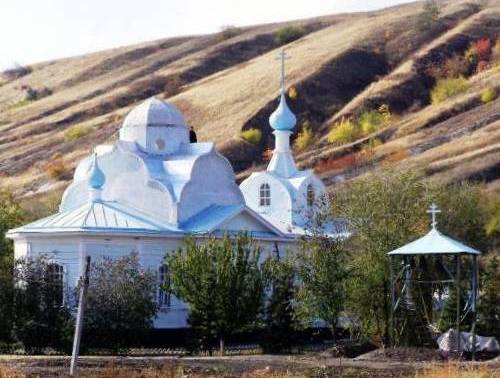
Nativity of the Most Holy Mother of God Convent
48.854570, 39.825273
- the document of appointment to the post:
Journal No. 21 session of the Holy Synod of UOC on 24.06.2015 year
The Nativity of the Most Holy Mother of God Convent of Luhansk Diocese grew up in the village of Krasnyi Derkul, Stanychno-Luhansk district, in the Luhansk region, on the site of a single-altar wooden church of the Nativity of the Most Holy Mother of God built in 18811, 2.
In the 1930s the church was closed: Komsomol activists dismantled the dome and belfry, smashed the iconostasis, removed the icons, built a stage in the western part and a projection booth in the altar, intending to set up a village club. The club's opening, according to the source, was twice inexplicably thwarted by smoke during film screenings, and the building was used as a grain store instead of a club4.
In January 1943, when the front line briefly passed through Krasnyi Derkul during the Soviet advance, a shell pierced the altar roof and fell to the floor without exploding; after the war parishioners repaired the church and reopened it4.
The future rector of the church was born on 7/20 June 1896 in the village of Krutyi Bereh in the Poltava region, into the poor peasant family of Petro and Vasa Obmok; while still a child he was placed in the Transfiguration Monastery in Lubny, where in 1923 Archbishop Hryhorii (Lysovskyi) of Poltava ordained Fedir a deacon, and a year later a priest4, 5.
In 1935 the Lubny monastery was closed a second time, and Father Fedir moved to the Donbas, where Archbishop Avhustyn appointed him rector of the Archangel Michael church in the village of Krymske in the Luhansk region; in 1937, while serving there, Father Fedir was arrested and sent to labour camps in Kolyma for ten years. He was released in the autumn of 1947, but in that same Krymske, where he was ordered to settle, he met only hostility - an official who had known him before his arrest drove the priest away4, 5.
In the stanytsia of Luhanska, archpriest Pavlo Kolomiitsev, the dean of the district, treated Father Fedir with compassion and sent him to serve in Krasnyi Derkul, which had no priest; Father Fedir walked almost 50 kilometres there on foot, and in the settlement he was received by the local psalm-reader Ivan Danylovych Verhunov4.
Having no episcopal appointment, Father Fedir served in Krasnyi Derkul for a time without a decree, until a tax debt forced him to travel to the diocesan administration; there Bishop Nykon himself arranged for the tax to be paid and, that same day, 15 January 1948, signed Decree No. 19 appointing Father Fedir rector of the Nativity of the Most Holy Mother of God church of the khutir of Krasnyi Derkul4.
On 30 November 1950 Father Fedir was tonsured a monk with the name Feofan at the Saints Peter and Paul church of the khutir of Verkhnia Chuhynka - the tonsure was performed by the rector of that church, hieromonk Antonii (Puzykov); in 1963 Archbishop Borys raised Father Feofan to the rank of hegumen, and in 1975 Metropolitan Serhii raised him to the rank of archimandrite and awarded him a mitre4, 5.
The Derkul church was robbed several times; the last, especially brazen attack took place on the evening of 22 September 1976, on the feast day of St Feofan the Confessor - the archimandrite's own name-day patron. Armed men tied up Archimandrite Feofan and the church warden and took money, watches and two adorned crosses; the elder described the attack in a letter to his spiritual children4.
Archimandrite Feofan died on 5 November 1982; the funeral took place on 8 November, the burial service was led by archpriest Borys Panov, secretary of the diocesan administration, and the elder's body was buried in the churchyard by the altar, along the south wall of the church4, 5.
According to a 2011 source, from the very founding of the monastery the community there was built up and cared for by Archimandrite Pavlo (Valuiskyi), who had previously served in the settlement of Verkhnii Minchenok; two children from his previous parish followed him there, and caring for them was the beginning of the convent's care for orphaned children2.
In 2008 the community acquired the former canteen of the joint-stock company Semenovod, measuring 550 square metres, and from 2009 was rebuilding it as a children's shelter; children came not only from Krasnyi Derkul but also from the neighbouring village of Krasna Talivka. That same year, 2009, the convent took in 33 children from a Luhansk orphanage, and they were baptised in the monastery church2, 3.
On 2 March 2011 the wooden church of 1881 burned to the ground: firefighters, who sent three vehicles and fifteen personnel, could not save it, and there were no casualties1.
On 16 March 2011 Metropolitan Ioanykii of Luhansk and Alchevsk signed the sketch design for the church's reconstruction - an exact replica of the burnt building - by architect Mykhailo Bulkin3.
Show sources
- 1. «ЛУГАНСК. Нужны молитвы и посильная помощь: в селе Красный Деркул Луганской области сгорел старинный деревянный храм» (UOC news). Православіє в Україні, інформаційний веб-портал УПЦ (orthodoxy.org.ua; сторінка недоступна, знімок Wayback Machine 15.04.2012), 2011 (accessed: 2026-09-02)
- 2. Юлия Воинова. «Красный Деркул. Начало нового времени» (UOC news). Православіє в Україні, інформаційний веб-портал УПЦ (orthodoxy.org.ua; сторінка недоступна, знімок Wayback Machine 12.03.2012), 2011 (accessed: 2026-09-02)
- 3. «16 марта – 13-й день жизни обители после пожара» (official site). Свято-Різдво-Богородичний жіночий монастир, власний блог обителі (krasnuyderkul.blogspot.com) - власний матеріал блогу, не передрук, 2011 (accessed: 2026-09-02)
- 4. А. М. Кудаев. «Феофан, архимандрит, старец Деркульский» (eparchy website). Українська Православна Церква. Полтавська єпархія (pravoslavie.poltava.ua; сторінка недоступна, знімок Wayback Machine 10.05.2013) (accessed: 2026-09-02)
- 5. «Феофан, архімандрит, старець Деркульський» (eparchy website). Новини Полтавської Єпархії (pravoslavie.poltava.ua) (accessed: 2026-08-31)
- Journal No. 21 session of the Holy Synod of UOC on 24.06.2015 year
