Novhorod-Siverskyy Transfiguration Monastery
52.008596, 33.282194
- the document of appointment to the post:
Journal No. 70 session of the Holy Synod of UOC on 27.07.2007 year
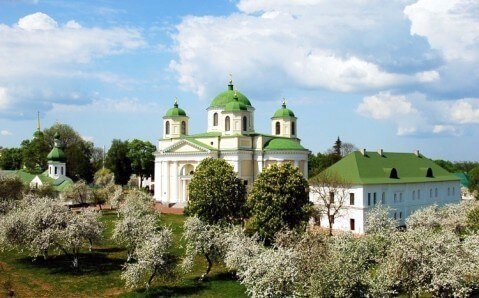
The Novhorod-Siverskyy Transfiguration Monastery stands on a hill above the Desna in Novhorod-Siverskyy. The sources give its foundation differently. Afanasiy Shafonskyi, in his Description of the Chernihiv Vicegerency of 1786, placed the event in 1033 and linked it with Prince Mstyslav of Chernihiv; some present-day authors date the appearance of the house to the end of the eleventh century; the Historical and Statistical Description of the Chernihiv Eparchy of 1873 gave grounds to think the monastery arose not later than the first half of the twelfth century, since its author dated the ancient stone Transfiguration church of the house to that time; while in the second half of the twentieth century archaeologists examined the remains of that church and assigned it to the turn of the twelfth and thirteenth centuries1.
The inventory of the house of 1785 stated that in 1176 the church suffered from fire during the sacking of the town in the princes' feuds. Under the year 1179 the chronicles report the burial of Prince Oleh of Novhorod-Siverskyy in a church of the Archangel Michael: by one account that church stood in Chernihiv, by another in the centre of Novhorod-Siverskyy, by a third in this house. In 2003, north of the foundations of the ancient church, the remains of a stone building were uncovered and, from the finds in it, called a princely country residence, destroyed in the Mongol invasion1.
At the turn of the fifteenth and sixteenth centuries the monastery received a charter of Prince Vasily III of Moscow granting it lands, and at the beginning of the sixteenth century it was laid waste by the Crimeans: its church in honour of Saint Peter, Metropolitan of Kyiv and Moscow, burned then, and so did that charter - which is known from a confirming charter of 15521.
In 1603 there stayed at the house a monk of the Chudov monastery in Moscow, Grigory Otrepyev, who entered history as False Dmitry I: leaving for the Polish-Lithuanian Commonwealth, he left a note in his cell calling himself a son of Ivan the Terrible. When the next year Novhorod-Siverskyy beat off his army, the monastery, which stood outside the town walls, was laid waste again for it. After Sivershchyna passed to the Commonwealth in 1618 the monks left for Russia, taking the vestments, icons, books, treasury and bells. In 1620 the house revived but lived in poverty, stripped of its former lands, and from 1635 to 1648 the Polish king gave it over to Catholics1.
In 1657-1672 the monastery served as the temporary residence of the bishop, and later archbishop, of Chernihiv, Lazar (Baranovych), who on taking charge of the eparchy found no place in Chernihiv for a bishop's house. He raised the house from ruin, saw to its endowment with lands and opened here a Slavonic-Latin school and a printing house, which he later moved to Chernihiv1. The look of the church as repaired in his time is preserved by an engraving on the title page of the Anthologion printed by the monastery press in 16782. In 1699-1701 the house was governed, with the rank of archimandrite, by the future Saint Dimitry of Rostov (Tuptalo, died 1709), who finished here the third volume of his Lives of the Saints1.
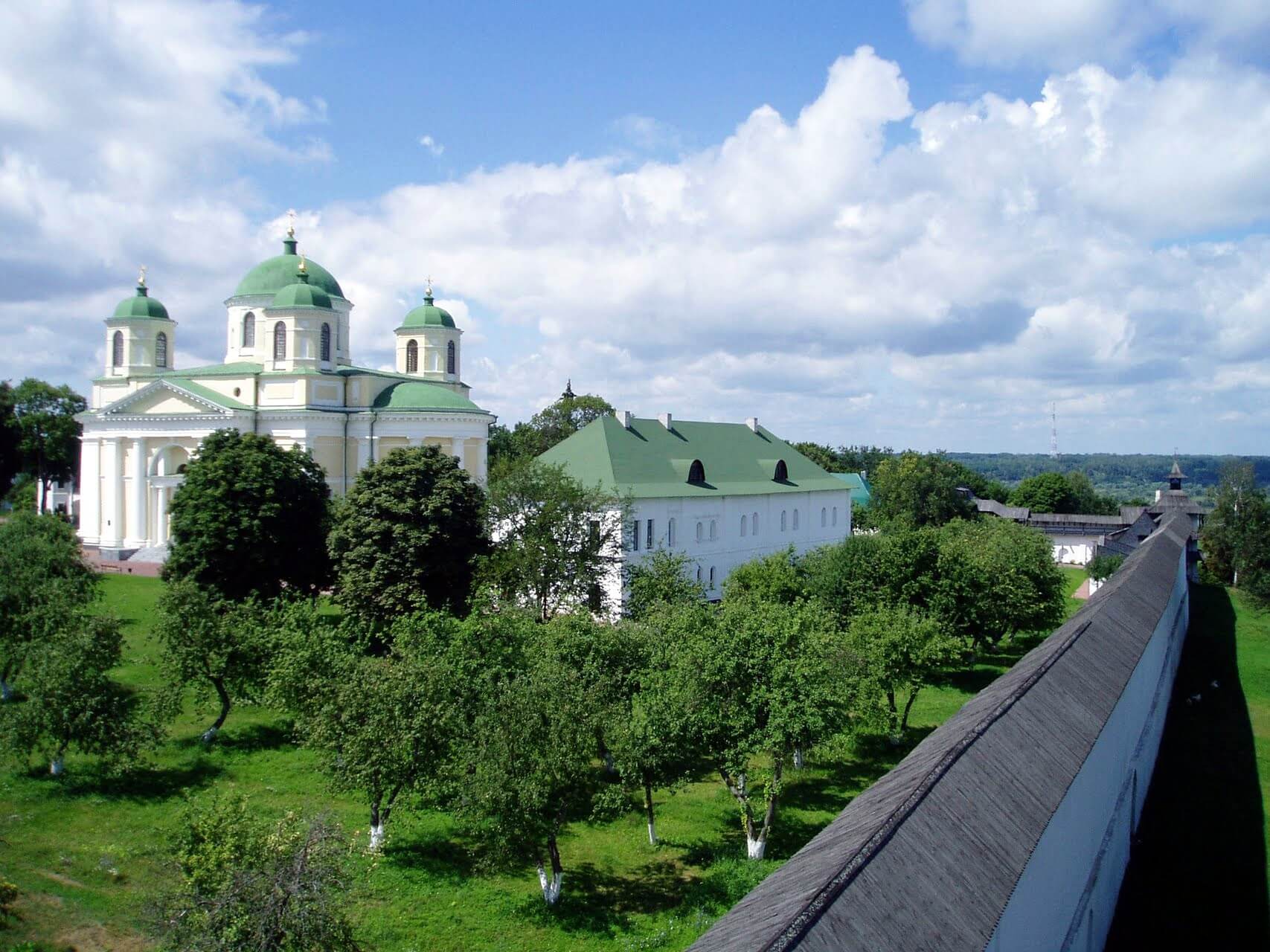
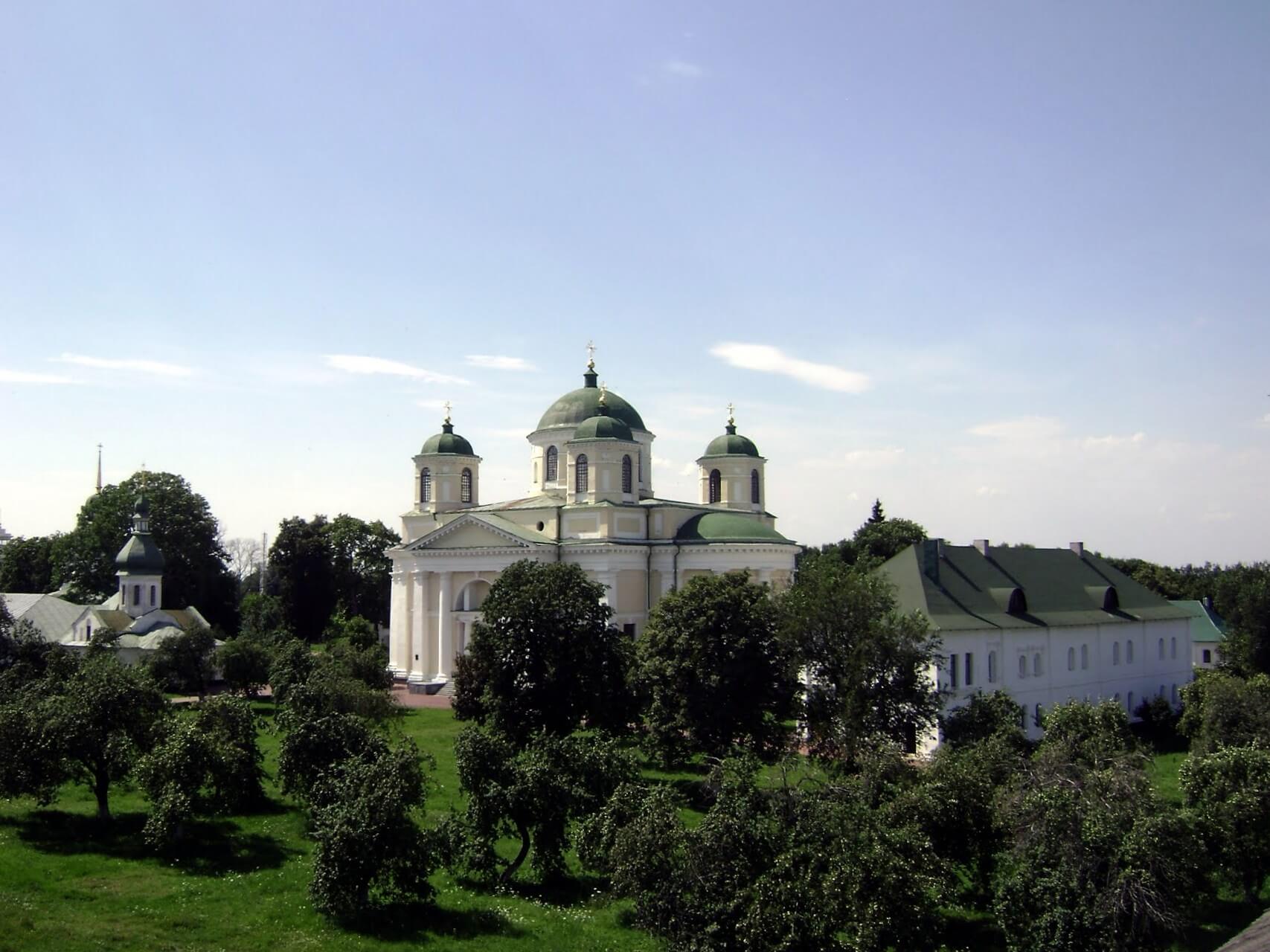
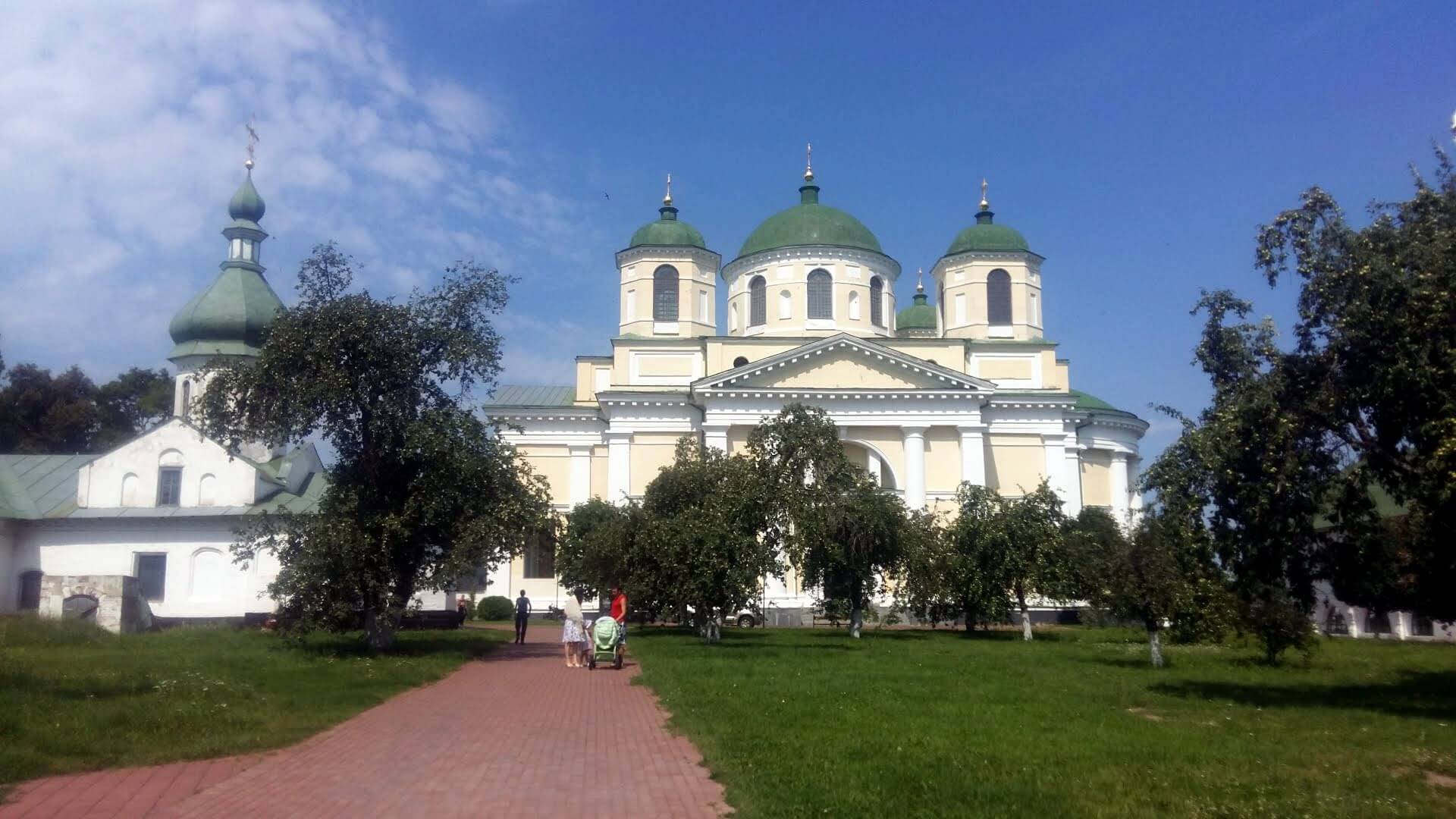
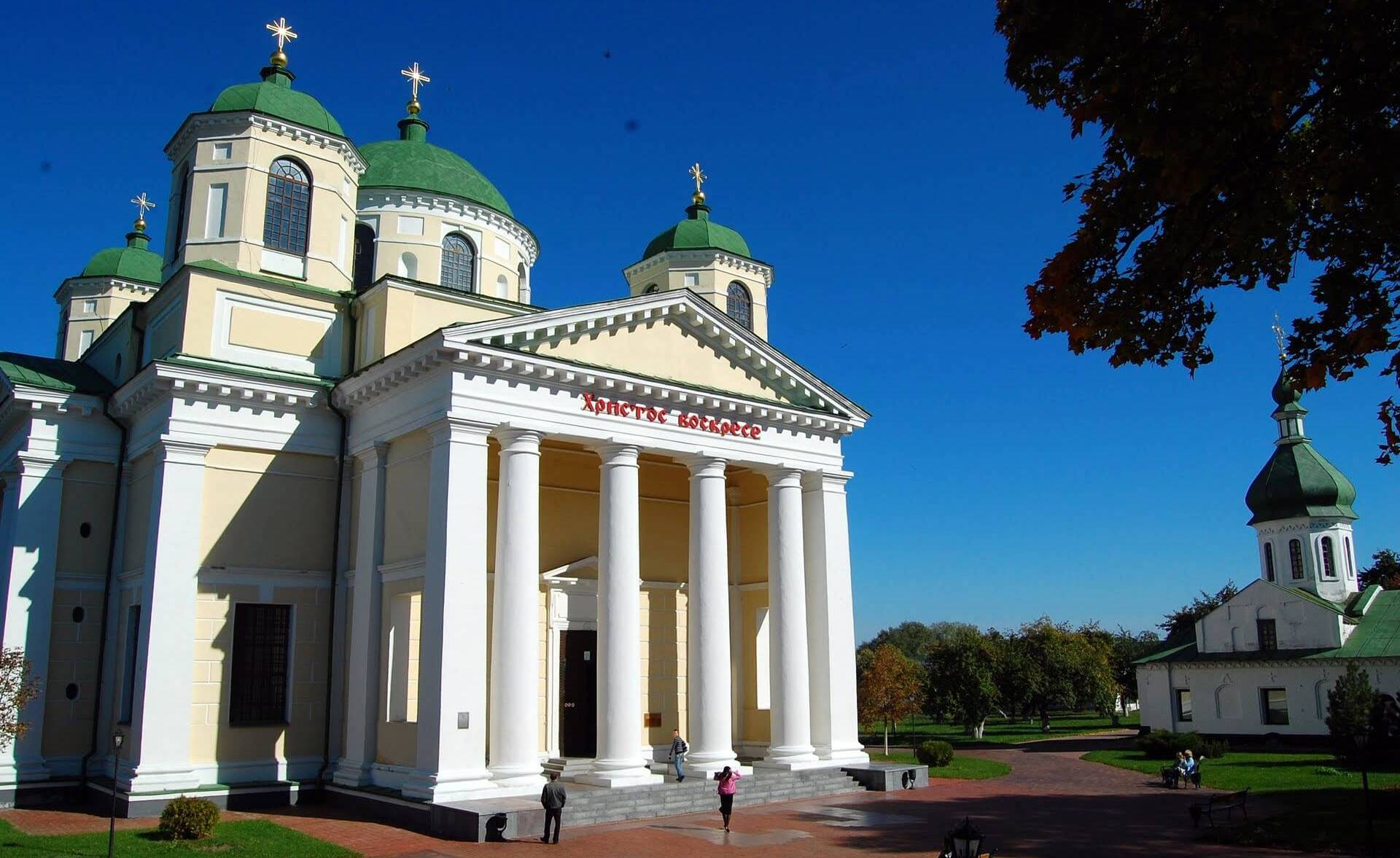
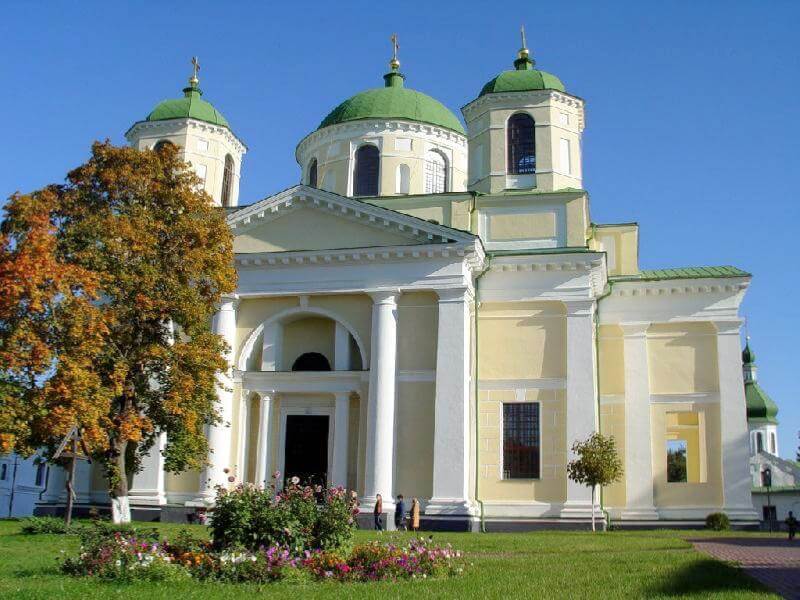
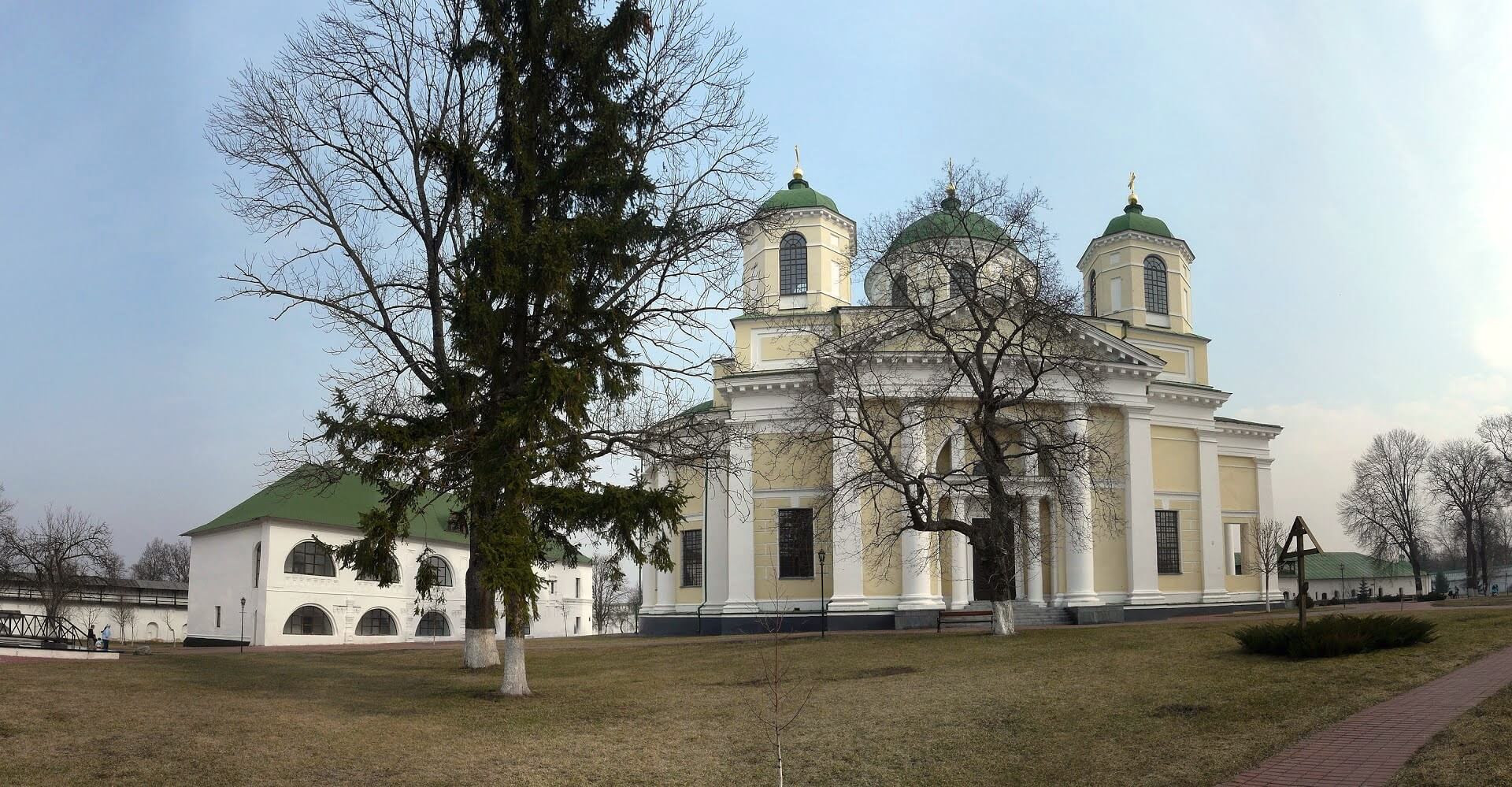
During the years of the separate Novhorod-Siverskyy eparchy, which existed from 1785 to 1797, its ruling bishop Ilarion (Kondratovskyi) lived at this monastery: he opened a seminary here and completed the church of the Prophet Elijah beside the superior's building. The church was consecrated on 24 January 1787 in the presence of Catherine II, who made a gift to the house that same day and later gave towards the new cathedral as well1. The ancient church was taken down in 1787, and in 1791 the present Transfiguration cathedral was laid on the same spot - five-domed, in the classicist style, to the design of the Italian architect Giacomo Quarenghi; the building work was directed by the architect Anton Kartashevskyi. In 1796 the cathedral was finished in the rough, the interior work and the consecration fell in 1806, but within ten years the building was in danger of collapse: against the contract the builders used weak brick and laid wooden ties into the walls instead of iron ones. In 1817 Kartashevskyi drew up a plan to strengthen the cathedral with additional columns; they were put in, and the church was consecrated anew in 18212.
In 1813-1823 the house held for life the deposed former archbishop of Mahilyow, Varlaam (Shyshatskyi), who went blind in his last years. Between the main church and the building where he lived a rope was stretched to serve him as a guide on his walks, and teachers of the Novhorod-Siverskyy gymnasium and of the theological school opened at the monastery in 1818 came to read books to him1. In 1838 the cathedral became the resting place of the remains of Aleksei Kyrylovych Rozumovskyi (1748-1822), son of the Hetman of Ukraine; the reburial was made at the wish of his family2.
In 1926 the house was closed. During the Nazi occupation a concentration camp was kept here in which twenty thousand people died, and in the fighting of 1943 for the liberation of the town the monastery buildings were badly damaged. In the 1950s Mykola Kholostenko excavated the foundations of the ancient church; by 1980 part of the buildings had been restored and adapted for the home for people with disabilities then housed on the grounds; in the 1980s the excavations were repeated and the fortifications by the holy gates restored. At the end of the 1990s monastic life revived at the monastery1.
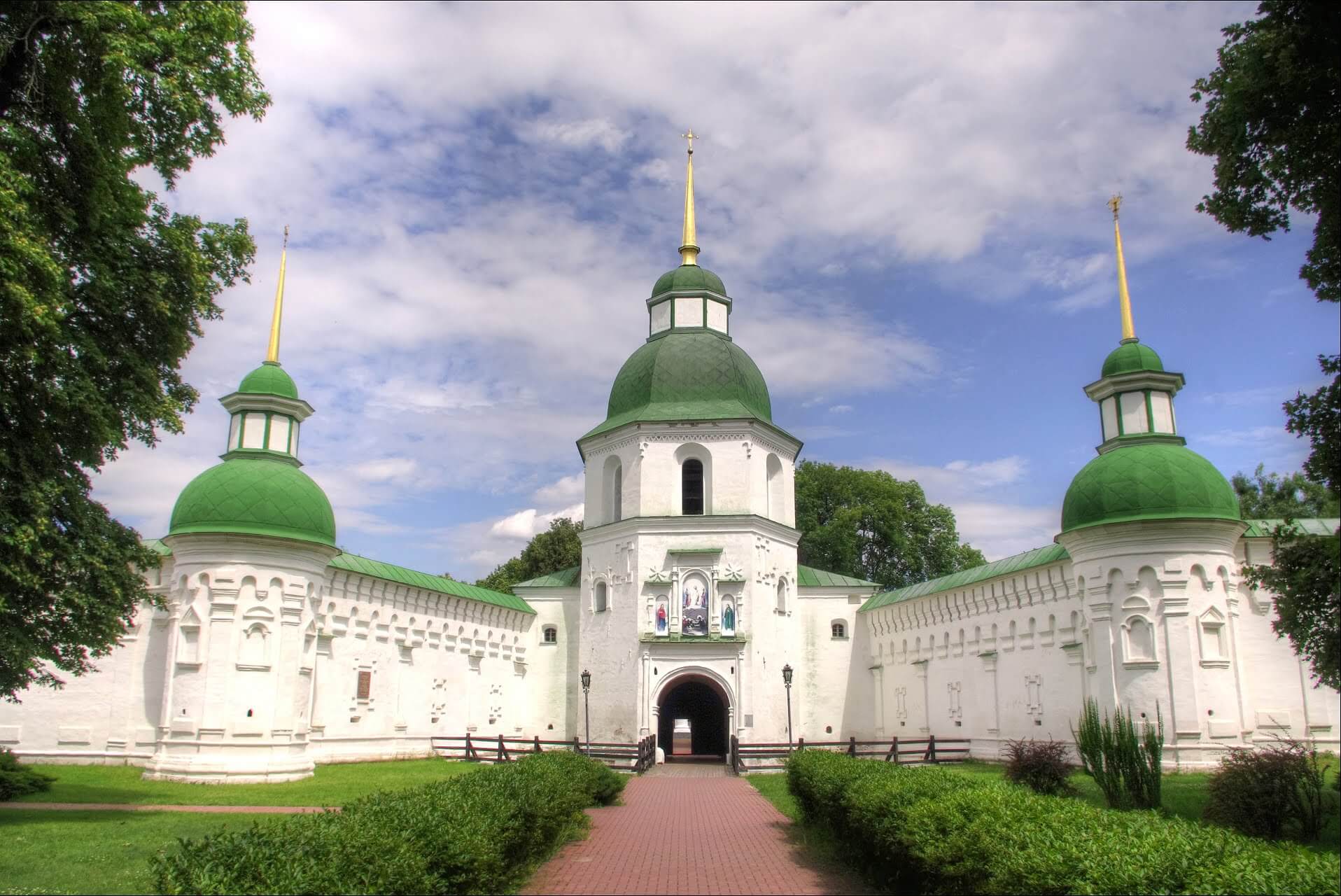
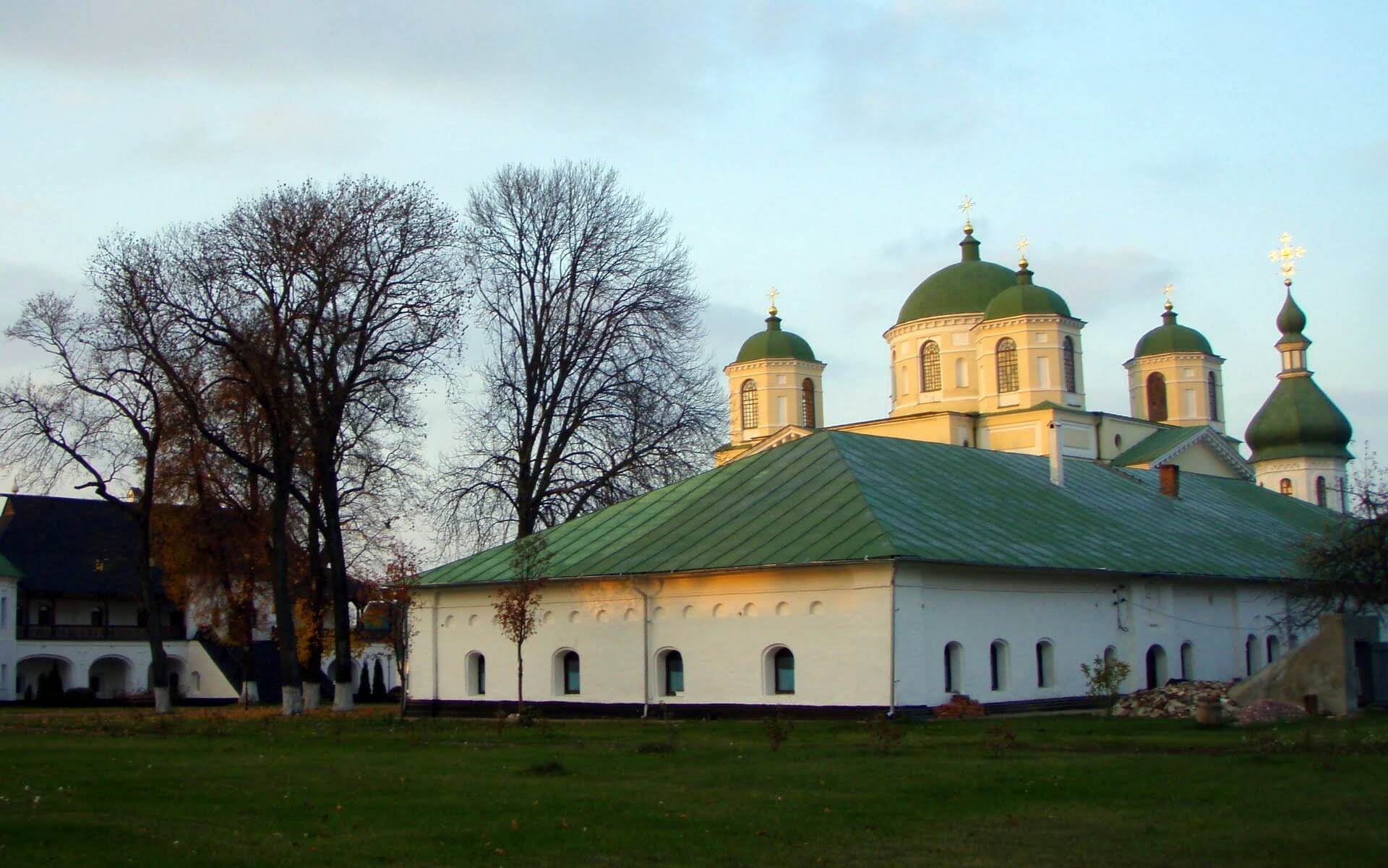
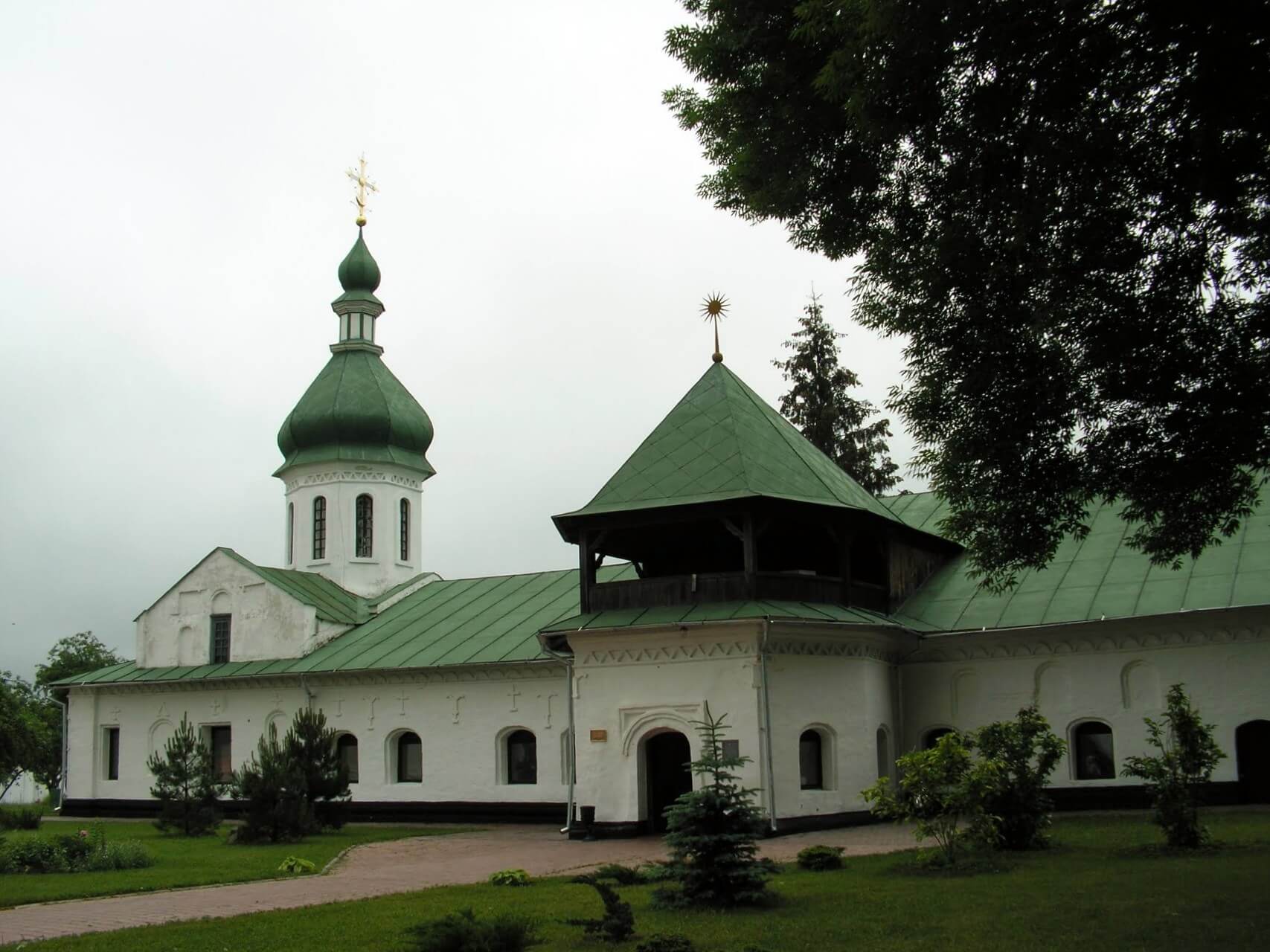
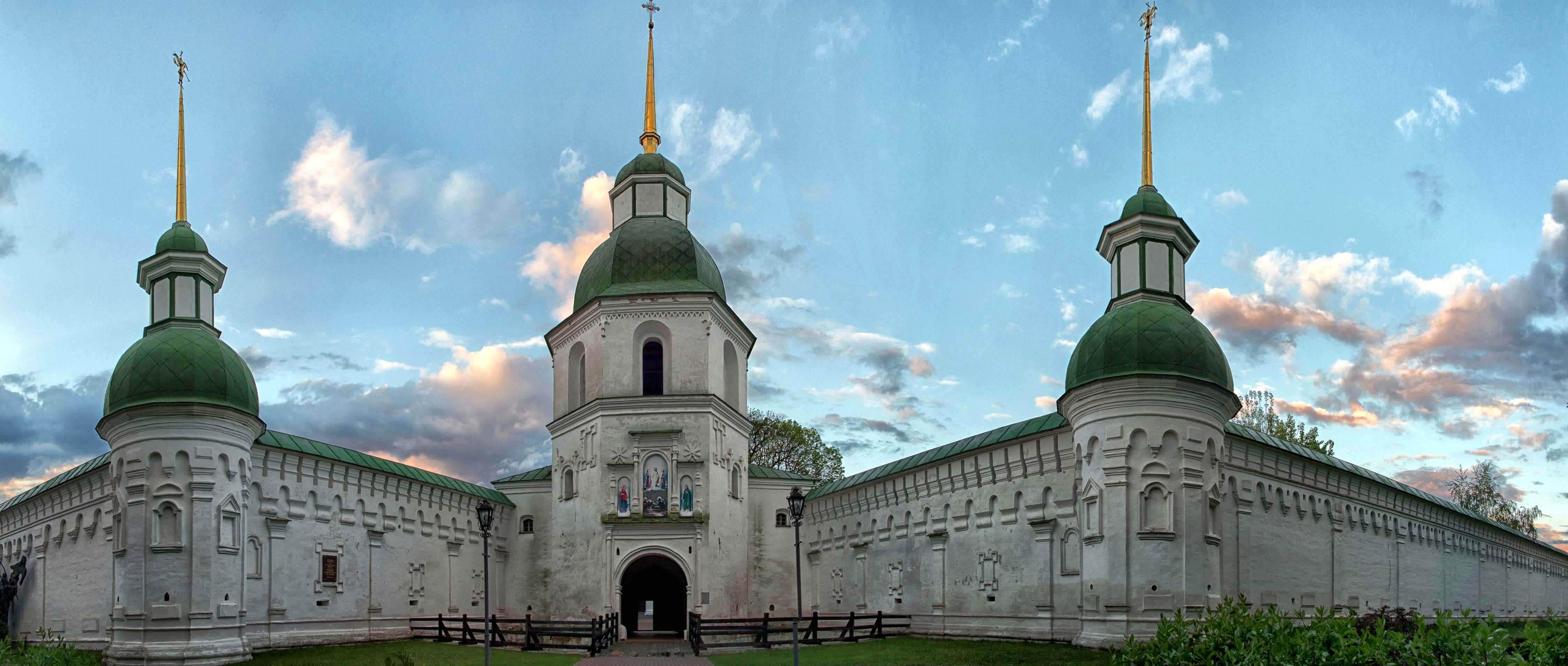
The precinct is close to a square in plan, its corners set to the points of the compass and enclosed by a fortress wall with towers, and on the axis of the holy gates the cathedral rises. The eight-sided bell-tower with the holy gates in its lower tier was raised at the turn of the sixteenth and seventeenth centuries; it was soon destroyed by an explosion, after which it was rebuilt without great change, while the other towers and the wall were put up at the end of the seventeenth century. South of the cathedral stands the Chamber building with the church of the Apostles Peter and Paul, a refectory hall and cells; to the west are the two-storey former quarters of the superior, now occupied by the museum of the Tale of Igor's Campaign; to the north-east is the bursa, built in 1657-1667 for the Slavonic-Latin school and recognised as a rare monument of civil architecture of the seventeenth century. Between the cathedral, the cells and the bursa lies the glazed archaeological excavation of 2003 with the remains of an old Rus stone building, and outside the walls stand monuments to the victims of the camp and to Yaroslavna - the second being part of a triptych of 1989 devoted to the Tale of Igor's Campaign2.
The house has a dependency: on 22 May 2003 a church of the Icon of the Mother of God "Unexpected Joy" was consecrated at the Novhorod-Siverskyy remand centre4. Among the holy things of the monastery is a copy of the Lenkovo icon of the Mother of God, the "Saviour of the Drowning", given to the house by a layman in 2003; by tradition the original was found on the bank of the Desna at the village of Lenkovo opposite a dangerous whirlpool where people often drowned, and after the finding of the icon such misfortunes grew rare and then ceased altogether3.
Show sources
- 1. «История» (official site). Спасо-Преображенський Новгород-Сіверський чоловічий монастир, офіційний сайт (novgorod-sev-mon.church.ua) (accessed: 2026-08-30)
- 2. «Архитектура» (official site). Спасо-Преображенський Новгород-Сіверський чоловічий монастир, офіційний сайт (novgorod-sev-mon.church.ua) (accessed: 2026-08-30)
- 3. «Святыни» (official site). Спасо-Преображенський Новгород-Сіверський чоловічий монастир, офіційний сайт (novgorod-sev-mon.church.ua) (accessed: 2026-08-30)
- 4. «Подворье» (official site). Спасо-Преображенський Новгород-Сіверський чоловічий монастир, офіційний сайт (novgorod-sev-mon.church.ua) (accessed: 2026-08-30)
- Journal No. 70 session of the Holy Synod of UOC on 27.07.2007 year
- Journal No. 26 session of the Holy Synod of UOC on 26.07.2004 year
- Journal No. 9 session of the Holy Synod of UOC on 08.07.2001 year
- Journal No. 26 session of the Holy Synod of UOC on 27.07.1999 year
- Journal No. 28 session of the Holy Synod of UOC on 15.04.1997 year