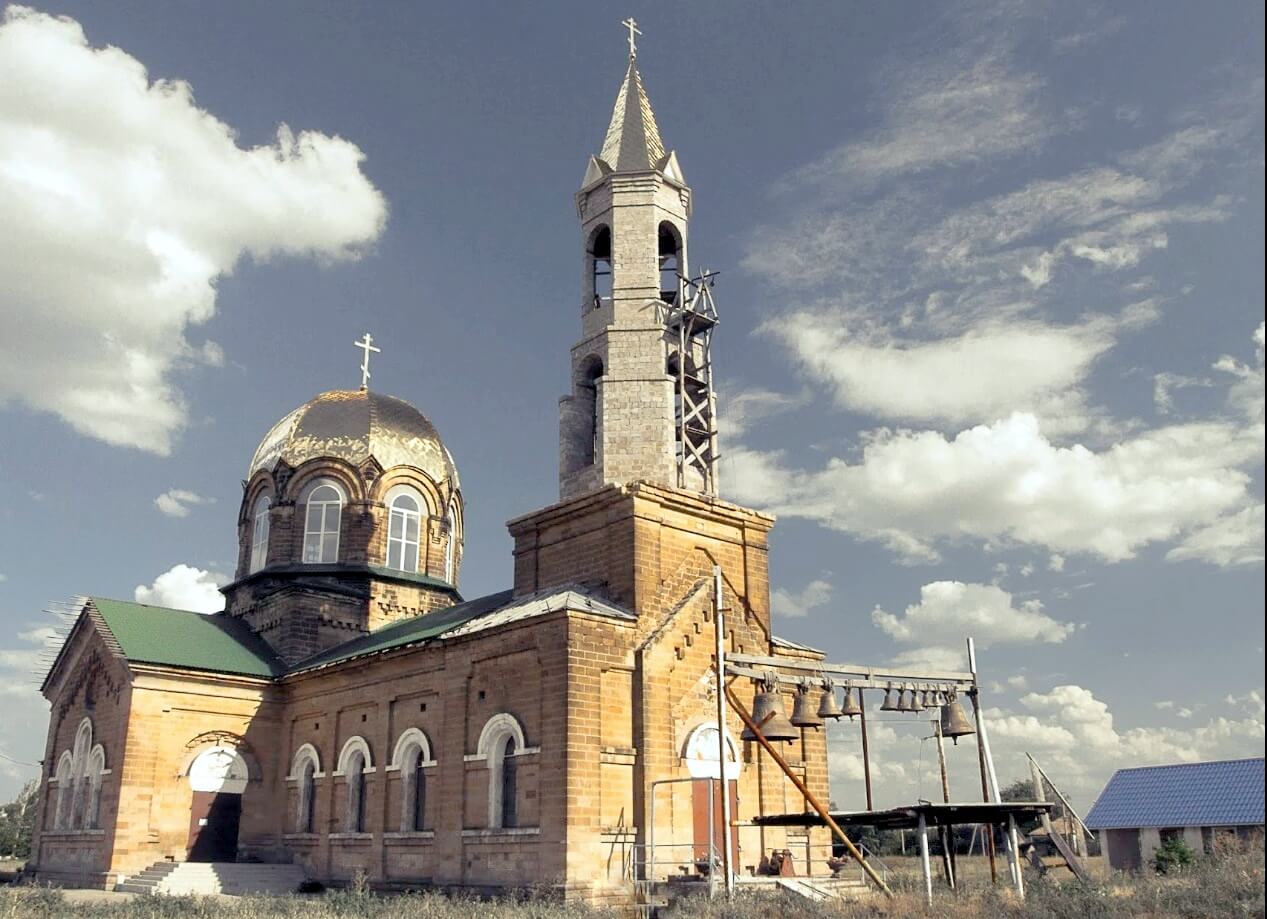
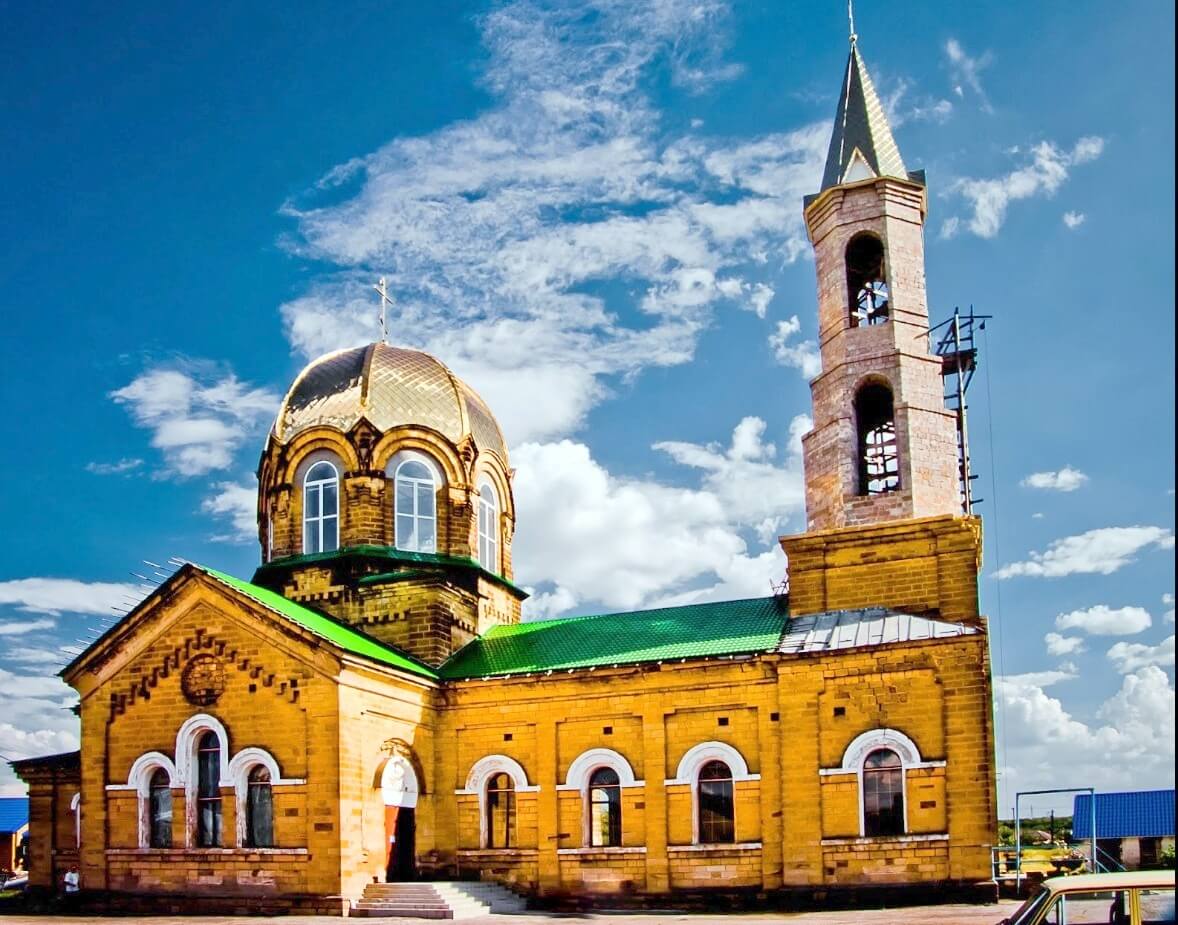
Ascension Monastery
48.626818, 38.837928
- the document of appointment to the post:
Journal No. 50 session of the Holy Synod of UOC on 25.04.2013 year
The Ascension Monastery of the Luhansk Diocese arose in the village of Khoroshe, Slovyanoserbsk district, in the Luhansk region, around an old stone church whose main altar is consecrated to the Ascension of the Lord1, 3.
The locality of the village was an ancient Zaporozhian holding and an old Cossack estate, and in 1756 it was given over entirely to Orthodox settlers, Wallachians who had come to these lands2. At the end of 1774 the inhabitants of the sloboda of Khoroshy Yar asked Bishop Aggei of Belgorod for permission and a blessing to build a church of the Hieromartyr Ignatius the God-Bearer, and in 1775 the church was laid2.
Then the building stopped for years. In a report of 26 October 1782 the Bakhmut spiritual board wrote to Archbishop Nikifor of Slaviansk and Kherson that the wooden church was still unfinished, neither boarded nor properly roofed, that the rain leaked through it so badly that services could not be held in it, and that the local priest Hryhorii Slavhorodskyi, reduced to poverty, was asking to be moved elsewhere2.
By the confession registers of 1782 the redoubt of Khoroshy Yar held 145 parish households, with 412 men and 372 women in them2. The report and the first orders of the diocesan authorities had their effect: to keep their priest and preserve a parish of their own, the settlers set to work at once, and in the spring of 1783 the Azov authorities submitted to Archbishop Nikifor a plan of the glebe land for the clergy2.
On 3 August 1784 the spiritual board reported that the church had been completely built, roofed with shingle, floored with a wooden platform and furnished for consecration; on 10 August a letter of blessing and a consecrated antimension were issued, and on 16 September 1784 the Bakhmut protopope Petro Rasevskyi, with the assembled clergy, consecrated in the sloboda of Khoroshy Yar the new wooden church of the Hieromartyr Ignatius the God-Bearer and opened divine service in it2, 3.
That first church has not survived4. After the old building burned down entirely in a fire, in 1910 the parishioners raised a new church of sandstone - with three altars, consecrated to the Ascension of the Lord, with side altars of the Hieromartyr Ignatius the God-Bearer and of the Prophet Elijah3, 4.
In the 1930s the parish was closed, and the belfry of the church was pulled down by order of the local authorities3, 5.
The community revived during the occupation in 1942 and took over the empty church building; the parish was officially registered on 10 November 1944 with 412 members5. Services were held until October 1965, after which the church was closed because the community could not sustain it financially5.
For about twenty years the building stood unused, and only in 1985 was it handed to the local state farm as a store - it served as a grain store and a fertiliser store, and in the nineteen-nineties there were even plans to demolish it3, 5. On 27 November 1989 the community was registered again, and the Ascension church was returned to it5.
Among the clergy of the church there are known A. Shcherbynovskyi, recorded for 1912, Oleksii Nikolskyi as of 1 January 1925, Ioakym Shepeliev from 1942, Onysym Loboda from 10 November 1944, then Andrii Tyshkin, Ioann Lysov, Mykhailo Sakhnovskyi, Vasyl Hrekov, Ioann Rubanov, Dmytro Vynohradskyi and Mykola Korabliev, who succeeded one another between 1946 and 1950, and Illia Dorda, who served from August 1956 to October 19655.
In September 2006 the Ascension Monastery was founded in the village of Khoroshe by the blessing of the ruling bishop, and the Luhansk Diocese likewise dates the beginning of monastic life on this site to 20063, 6. That year, by the blessing of Metropolitan Ioannykii (Kobzev), eight monks came to the village to build a house here: the Ascension church was then in use but without a belfry, and around it lay nothing but waste ground overgrown with grass3. In time the brethren raised a belfry on the old church3.
The chapel over the spring of the Great Martyr Paraskeva Pyatnytsia at Miusynsk was destroyed under Soviet rule, and the Miusynsk church itself was destroyed soon afterwards7. The rebuilding of the chapel could not be resumed until the autumn of 2004: on 4 October the assembled clergy consecrated the cupola and the cross, and on 10 November the newly built chapel was solemnly consecrated - the icon of Saint Paraskeva from the old chapel had been kept for this for thirty years7.
In 2008 the Miusynsk church and the holy spring were handed over as a skete of the Ascension house of the village of Khoroshe7. By 2012 the spring was already in the care of the monastery's brethren, services had resumed in the church beside it, and a reliquary with a particle of the relics of Saint Nicholas the Wonderworker was permanently kept at the house8.
The Częstochowa icon of the Mother of God was held to be the principal shrine of the church at Khoroshe5. The house also kept the Dubovychi icon of the Most Holy Mother of God, a particle of the Wood of the Life-Giving Cross of the Lord and a particle of the relics of Saint Nicholas9. The Dubovychi image takes its name from the village of Dubovychi in the Chernihiv region, where it has been known since the sixteenth century; under Soviet rule a devout family hid about sixteen icons from the manor house from the communists, this one among them, the icon was afterwards kept for a time in Kyiv, and before his death its keeper bequeathed it to a monastery10.
On 17 August 2012 the reliquary with a particle of the relics of Saint Nicholas from the Ascension Monastery of the Luhansk Diocese was brought to the St Nicholas cathedral of Dniprodzerzhynsk, from where it travelled the churches of the Solonyanske deanery12. And on 16 August of that year, by the blessing of Archbishop Mitrofan of Luhansk and Alchevsk, the brethren of the house set out on a pilgrimage to the holy places of Serbia and Montenegro11.
An icon-painting workshop worked at the house and took commissions for icons13; the house itself made candles and packed Greek incense from Athens14. On its grounds the building of churches of Saint Spyridon of Trimythous and of the Częstochowa icon of the Most Holy Mother of God was going on4.
On 25 April 2013, on the report of Archbishop Mitrofan of Luhansk and Alchevsk, the Holy Synod of the Ukrainian Orthodox Church by journal No. 50 blessed the opening of a male monastery in honour of the Ascension of the Lord of the Luhansk Diocese on the site of the parish in honour of the Ascension of the Lord in the village of Khoroshe, Slovyanoserbsk district, and also blessed the registration of the house's statute1. The Luhansk Diocese reported that on the same day the Synod granted the status of monasteries to two monastic communities of the diocese15.
On 28 April 2013, the sixth Sunday of Great Lent, the feast of the Entry of the Lord into Jerusalem, Archbishop Mitrofan celebrated at the house the Divine Liturgy of Saint John Chrysostom; during the little entrance the secretary of the diocese read out journal No. 50, and after the eucharistic canon the bishop performed an ordination to the diaconate16. The archpastor congratulated the people on the historic event that had taken place that day within the walls of the newly formed house, and this was the first service held there together16.
On 12 June 2013, on the eve of the patronal feast, an all-night vigil was served at the house's skete at Miusynsk: the small church of the skete, likewise consecrated to the Ascension of the Lord, could barely hold those who came to pray17. On 13 June the house celebrated its patronal day17.
On 28 June 2013 a moleben was served at the skete beside the spring of the Great Martyr Paraskeva, where the building of a font was going on17. On 7 July a particle of the Belt of the Most Holy Mother of God was brought to Miusynsk; more than six hundred people came for the procession from the wayside cross to the holy spring, and such processions on the tenth Friday after Easter had become a pious tradition there17.
On 16 April 2013 the Luhansk church of All Saints, by the trolleybus depot, received the thorn from the Saviour's crown of thorns, which was then being carried in procession through the Luhansk Diocese18. The place is known for the chapel of the elder deacon Filip; according to the house, part of a tree that turned to stone at the elder's prayers is kept in the courtyard of the church complex, and the venerated Luhansk icon of the Most Holy Mother of God is in the chapel itself18. On 30 June 2013 the patronal feast was kept in that church17.
Show sources
- 1. «Засіданя 25 квітня 2013 року» (church document). Священний Синод Української Православної Церкви (sinod.church.ua), 2013 (accessed: 2026-09-01)
- 2. «село Хорошее» (official site). Свято-Вознесенський чоловічий монастир, офіційний сайт (monastyr.lg.ua), архівна копія (accessed: 2026-09-01)
- 3. «Хорошее. Свято-Вознесенский мужской монастырь. Церковь Вознесения Господня» (heritage register). Народный каталог православной архитектуры (sobory.ru) (accessed: 2026-09-01)
- 4. «Наши Храмы» (official site). Свято-Вознесенський чоловічий монастир, офіційний сайт (monastyr.lg.ua), архівна копія (accessed: 2026-09-01)
- 5. «Хорошее. Вознесенский мужской монастырь» (heritage register). Народный каталог православной архитектуры (sobory.ru) (accessed: 2026-09-01)
- 6. «09.10.16 с.Хорошее. Десятилетие со дня рождения монашеской жизни» (eparchy website). Луганська єпархія Української Православної Церкви (eparhia.lg.ua), архівна копія, 2016 (accessed: 2026-09-01)
- 7. Беляев Георгий Юрьевич. «Святой источник города Миусинск» (academic publication). Історико-краєзнавче видання, опубліковане на сайті Свято-Вознесенського чоловічого монастиря (monastyr.lg.ua), архівна копія, 2008 (accessed: 2026-09-01)
- 8. «Крестный ход с мощами Свт. Николая Чудотворца» (official site). Свято-Вознесенський чоловічий монастир, офіційний сайт (monastyr.lg.ua), архівна копія, 2012 (accessed: 2026-09-01)
- 9. «Святыни» (official site). Свято-Вознесенський чоловічий монастир, офіційний сайт (monastyr.lg.ua), архівна копія (accessed: 2026-09-01)
- 10. «Дубовичская икона Пресвятой Богородицы» (official site). Свято-Вознесенський чоловічий монастир, офіційний сайт (monastyr.lg.ua), архівна копія (accessed: 2026-09-01)
- 11. «Жизнь обители» (official site). Свято-Вознесенський чоловічий монастир, офіційний сайт (monastyr.lg.ua), архівна копія, 2012 (accessed: 2026-09-01)
- 12. «Крестный ход в Днепродзержинской епархии» (official site). Свято-Вознесенський чоловічий монастир, офіційний сайт (monastyr.lg.ua), архівна копія, 2012 (accessed: 2026-09-01)
- 13. «Иконописная мастерская» (official site). Свято-Вознесенський чоловічий монастир, офіційний сайт (monastyr.lg.ua), архівна копія (accessed: 2026-09-01)
- 14. «Монастырское производство» (official site). Свято-Вознесенський чоловічий монастир, офіційний сайт (monastyr.lg.ua), архівна копія (accessed: 2026-09-01)
- 15. «25.04.13 В Луганской епархии образованы два новых монастыря.» (eparchy website). Луганська єпархія Української Православної Церкви (eparhia.lg.ua), архівна копія, 2013 (accessed: 2026-09-01)
- 16. «28.04.13 Вербное воскресенье. Богослужение в Свято-Вознесенском монастыре.» (eparchy website). Луганська єпархія Української Православної Церкви (eparhia.lg.ua), архівна копія, 2013 (accessed: 2026-09-01)
- 17. «Летопись монастыря» (official site). Свято-Вознесенський чоловічий монастир, офіційний сайт (monastyr.lg.ua), архівна копія, 2013 (accessed: 2026-09-01)
- 18. «Крестный ход с Шипом Тернового Венца Христа Спасителя. Встреча святыни в часовне старца диакона Филиппа.» (official site). Свято-Вознесенський чоловічий монастир, офіційний сайт (monastyr.lg.ua), архівна копія, 2013 (accessed: 2026-09-01)
- Journal No. 50 session of the Holy Synod of UOC on 25.04.2013 year